

Month: December 2018
How to Find the Inspiration To Go From Good To Great
the magic 1%

Do you really need the elusive 1% of inspiration, or is 99% perspiration enough to get the job done?
Inspiration is one of those ideas people use to separate artists from the rest of the population. Popular culture shows an artist writing or playing or painting like a person possessed, forgetting to eat or wash in the process. They’re overwhelmed by the spirit of creation and must capture it before they lose it.
Perhaps as a reaction to that, many no-nonsense creators simply dismiss it. Show up, do your work, and you don’t need inspiration. Once you start, you’ll find whatever you need along the way. Prolific and successful writers such as Stephen King and Nora Roberts have no time for inspiration, dismissing it as an excuse for failure to produce.
You might share one or other of these views. You may have been inspired and found the experience both thrilling and elusive to repeat, like trying to catch lightning in a bottle. Or you get on with hitting your daily word count and find that’s more than enough.
But is it possible that both viewpoints are true?
Seeking The Muse
All the effort in the world won’t matter if you’re not inspired.
Chuck Palahniuk, Diary
The Nine Muses of Ancient Greece were goddesses who symbolised arts and sciences such as poetry, singing, astronomy, drama, and so on.
Artists of the time called on their muse to bring forth their best work.
The idea of the muse as inspiration persisted into the last century, often personified as a woman who inspired a male artist. Sometimes an artist in her own right, she embodied an artistic concept for the man whose work often featured her as a model. Dali, Picasso, Rossetti, and Rodin all drew on their significant relationship with a woman, while Francis Bacon’s muse was male.
The muse reflected the artist’s vision while also challenging him. Her presence as model or sounding board encouraged him to push the boundaries, infusing his pieces with more energy and no doubt encouraging him when the results were viewed with confusion or disdain. Every movement that we now accept in art began with artists who dared to go further, risking the scorn of their contemporaries.
The muse shines her light on a new path and whispers in the artist’s ear, “That is your way forward. Be brave.”
Stealing Fire

Inspiration exists, but it has to find you working.
Pablo Picasso
Creativity and inspiration are not the same things. They can exist separately or together.We’re all creative, but we’re not always inspired. You can make a cake or write a story by gathering your materials and starting. The result will be perfectly serviceable if you know what you’re doing.
But if you have inspiration, you can create something much more. Inspiration turns good into great, and great into sublime.
Think about the last time you were struck by an idea. It seemed to come from nowhere. Perhaps you were in the shower or thinking about something else entirely. Perhaps you were half-way through your piece and suddenly you went off in a different direction, as though a billiard ball collided with you.
It’s impossible to explain. You might say your characters told you what they wanted, or that you had a hunch, or you shrug your shoulders and say it just felt right.
The Ancient Greeks would say your muse had whispered in your ear. Science says that it happened in your brain. Your brain is a collection of a trillion neurons and a quadrillion synapses, a self-regulating system capable of near-miraculous processing.
Neuroscience has evidence that the creative act may involve enhanced neural processes. Normal pattern recognition steps up to a level where the brain can make new connections. That’s creativity – connecting things.
Put another way, you can make a fire with two sticks rubbed together and oxygen. Both are essential and together they are sufficient, with enough effort.
But add a spark and you shorten the process. The spark is neither necessary nor sufficient on its own. But allied to enough kindling and skill, your efforts can go into making a bigger, brighter flame.
Fire = kindling + oxygen + skill
Creation = spark of inspiration + kindling of ideas + skill
Now you need to make sure that inspiration can find you, ready and waiting.
The Power of Habit
Whether it’s a painter finding his way each morning to the easel, or a medical researcher returning daily to the laboratory, the routine is as much a part of the creative process as the lightning bolt of inspiration, maybe more.
Twyla Tharp
Every act of creation has process at its heart. Every marvellous work you admire is rooted in skills which are hard won and honed by repetition. So before you think about being inspired, you have to do the work of being able to do the work. Always.
If your spark drifts by and your eyes are closed, you’ll miss it. If you have no materials, or there is no oxygen, you won’t be able to use it. This is where a routine is your friend and constant practice is your teacher.
Forget about inspiration and work on your craft daily. You need to level up before you can take advantage of it. Put in the work to improve. Check your progress with whatever measure you like, just be sure that you’re doing better work, not just more of the same.
The rules of writing (painting, photography, or anything you like) can be tedious and boring to learn. Learn the rules anyway, so that when inspiration strikes you know which to break and which to follow. Put in the training miles so that when spark meets kindling, you’re ready.
Breathing Space
Inspiration is there all the time. For everyone whose mind is not clouded over with thoughts whether they realize it or not.
Agnes Martin
Just as a flame needs oxygen, inspiration thrives in open space. An open mind is unusually receptive to new patterns. You need to clear out the constant chatter of conscious thought. Meditation may be useful but it’s not absolutely necessary. Daydreaming, naming clouds, or watching a raindrop crawl down a window can all quiet the mind and allow new ideas to surface.
Some people get their breakthroughs while in the shower. It’s a time for most of us to let our brains idle. For others, free-writing nudges thinking into a less directed state, as in the morning pages of The Artist’s Way.
Some people move around. Walking, running, swimming or even sweeping a floor might work for you.
A Chance To Dream
You can’t wait for inspiration. You have to go after it with a club.
Jack London
A tired mind is a slow mind, barely able to cope with the familiar let alone come up with something new. Lack of sleep is so common these days that it’s seen as normal, but to be truly creative you need sufficient rest. The average is six to nine hours, so experiment and find your ideal. Work back from your rising time to find when you need to go to bed.
Find advice about establishing a good sleep habit here or here. It will lengthen your life and make it much more pleasant when awake.
The other reason to sleep more is to get enough REM sleep, the phase during which we dream. Often this phase occurs just before waking naturally, so if your alarm wakes you before you complete your sleep cycle you will miss out.
If you can remember your dreams, keep a notebook by the bed to write them down on waking. Sleep allows the conscious brain to rest and the subconscious to work without distraction. There’s some evidence this can result in more creative insights. Dream recall can be difficult to start but improves with practice.
Everything Is Material
How vain it is to sit down to write when you have not stood up to live.
Henry David Thoreau
If creativity is connecting things, make sure you have plenty of material to work from. You’ll have to sift through a lot of rocks to find that nugget of gold.
Get out from your routine and search out something new.
Read something outside your comfort zone, outside your genre. Read non-fiction, look at architecture or a photography magazine. Read a novel you think is trashy and one you think is classic. Re-read the books you loved when you were twelve, or twenty-one.
Visit a museum and spend thirty minutes with a single exhibit. Examine it from all angles. Think about the materials and techniques that made it. Imagine it in your sitting room. Take a picture for later. Print the picture and sleep with it under your pillow.
Talk to people properly, by which I mean ask them about themselves and listen to the answers. We all have a tale to tell and some of them are fascinating.
Visit an unfamiliar place. This could be a new town or part of your hometown where you never go. If you live in a city, take the tourist bus tour and learn something new. Look up at buildings, notice carvings and old facades. Sometimes all you need to do is raise your eyes to see much more.
A Marriage of Opposites
It’s a dull world without inspiration. And without perspiration and effort, nothing would be realised. We need both.
When you feel like you’re just plodding along and you’re missing something, seek inspiration.
Build your skillset, sharpen your tools, challenge your capabilities.
Be curious, give your brain space to spark new connections, and always be seeking out new materials to feed it.
If anyone can make this marriage of opposites work, it’s a creative person like you.
Go to it.
To depend entirely upon inspiration is as bad as waiting for a shipwreck to learn how to swim. To leave everything to natural spontaneity is as bad as to make everything the result of mechanical predetermination… perfection is the harmonious blending of the two.
Francois Delsarte
Have a comment or suggestion? Drop it below.


How To Keep Going When You Feel Like Giving Up

10 steps to let your body carry your mind
What doesn’t kill you doesn’t always make you stronger.
Sometimes life is more than you can bear, piling one stress on top of another. You barely have time to recover from one blow before the next one falls.
Holidays are often the most difficult time as you try to cope with high expectations that far exceed the resources available. You’re surrounded by glossy images of people and lives that don’t match your reality. It’s painful.
As a creative person, you suffer from creative block. New ideas don’t come and making anything at all feels like swimming through molasses. This only adds to your sense of failure.
You limp on, but every day is harder. It’s harder to get out of bed, harder to attend to commitments, harder to care about anything or anyone, including yourself.
You want it to end. Your spirit threatens to shatter under an immense load of bad thoughts, feelings, or events.
The sky is dark.
Your strength is gone.
What can you do now?
Maybe all your brain wants is oblivion, but your body only knows one thing. Even when broken, even at the extremes of pain and suffering, the body strives to go on.
Supporting your body can help your mind.
Often we neglect our physical wellbeing when we feel low. We’re caught up in mental and emotional battles. Our physical needs are just another burden to carry, so we ignore them.
Acknowledge those battles, and set them aside for now. Rather than being consumed by thinking and feeling, do something practical to help yourself.
You need to focus on survival. It’s strange but true; the mind rests easier in a body that is usefully occupied. You need both working together to feel better.
Mens sana in corpore sano.
A healthy mind in a healthy body.

10 Steps To Feel Better
- Get clean. Shower, wash your hair and brush your teeth. Then make your bed. This will give you a sense of achievement early in the day. If the day doesn’t go so well, you’ll have a tidy bed to come back to.
- Get dressed in fresh clothes. Wear something soft against your skin according to the temperature. Put on warm socks if you’re cold.
- Drink water. Cold, hot with lemon, tea, coffee, hot chocolate, whatever appeals. Then, drink more water regularly through the day. Even mild dehydration causes irritability and fatigue.
- Eat something easy like cereal, fruit, yogurt, or a sandwich. Missing meals can cause periods of low blood sugar, which in turn leads to symptoms such as anxiety, shakes, and brain fog. Eat little and often.
- Put on your favourite upbeat music to distract you from negative internal thoughts constantly running though your head. Wearing headphones can also help. You might prefer the radio, but avoid news programmes. The relentless focus on bad news stories is not helpful right now.
- Some or maybe all of your environment is out of control, mirroring your internal state. Pick a room where you spend a lot of time. Start in one corner and tidy up. Wash dirty dishes, put on laundry, and take out the trash.
- When feelings arise about the process, note them and keep going. Remember this is practical, not emotional. You can write them down which allows your brain to let go. Look at them when you feel calmer.
- If someone has offered their support and you feel able, ask them to keep you company and/or help you. Sometimes we don’t need someone to hold our hand as much as we need them to tidy the kitchen we can’t face any more.
- Go outside. Breathe fresh air, turn your face to the sun, stand barefoot on the grass and connect. If weather or other issues prevent this, open a window for a few minutes. Bodies need oxygen and sunlight.
- If you are able, get moving. A simple repetitive task like cleaning windows, mopping floors, pulling weeds, or walking can all help. Sing along with your music. You’ll feel calmer and achieve something, and that’s a double win.

Hard But Not Impossible
If you are feeling some December blues, or even depression, don’t fight it. Instead, do something for yourself. Be reflective. Let the emotions exist. And be encouraged that, like me, you can get to a better place, but it can take time.
Brad Feld
I know this isn’t easy. I also know that you can work through this and come out feeling better than you do now.
You will be distracted by the pain. Tell yourself you will come back to it later, and concentrate on the task at hand.
Don’t try to empty your mind of all thoughts. Mindfulness means noticing your thoughts, letting them go, and returning to one point of focus. Imagine thoughts are like clouds in the sky drifting past.
Counting breaths or steps, reciting prayers or mantras, all help to still the mind.
Helping others can be very therapeutic. But we can’t give what we don’t have. Practise self-care so that you’re in the best shape to face the world. Making yourself your first priority is not selfish, it’s essential to your survival.
Remember we’re all different, and YMMV. Try different things and see what works for you. Return to it when life gets tough, before things spiral too far downwards.
Sometimes we sink deeper, and it takes more effort to climb out of the hole. Get to know your early warning signs, and act on them.
When you follow these steps you will find
- your body is comforted and nourished
- your environment is more restful
- your sense of control increases
- your mind is calmer
A break from pain frees up mental energy you can now use to address the underlying issues, with professional help if needed.
I hope you find something here that helps you move forward. This is not meant to be the only answer, rather it’s a set of suggestions to get you started.
But if you really feel you can’t go on and ceasing to exist seems like the only way out, please stop and reach out.
Help is available here. There is always another solution.
Sometimes, just surviving another day is the victory. Let your body carry your mind until you feel better.
Have a comment or question? Drop it below.
How To Make Your Writing More Engaging
attract and keep your audience

If you build it, he will come.
Field of Dreams
You want views, and reads, and fans for your writing. We all do. You’ve been posting for a while now, but not seeing the results you want.
You’re not too discouraged yet, but you definitely feel like there’s something missing, and if you could only find out what to change you could move forward.
Perhaps you’ve fallen into the trap of believing that if you build it, the readers will come. That depends on what you build and who you hope to attract.
Getting readers to come, stay awhile and return isn’t easy, no matter what the latest guru might say. And if they don’t come, the swamp of suck will get you.
If you can’t build and keep momentum, loss of motivation will soon follow. Like running headlong into quicksand, discouragement slows you down and pulls you under. Avoid that by making your writing more engaging, regardless of subject.
Make Them An Offer They Can’t Refuse

The purpose of the headlines must be to convey a message to people who read headlines, then decide whether or not they will look at the copy.
John Caples
The headline is your shop window. The world is a noisy place and you have to work hard to catch readers. That might mean tricking people into looking your way; lure them with the candy of an eye-catching banner, then feed them the wholesome food of your content.
It’s fashionable to sneer at so-called clickbait headlines that so often lead to worthless content. But looking at their structure can teach you what attracts attention. Then you can get your good content in front of more people.
Your potential reader will make a decision to stop and read or scroll on based on the offer in the headline. Copywriters and advertising have a lot to teach writers about headlines. We often spend little time on them, but they are as important as the content. If the reader doesn’t stop, he can’t be persuaded by our words.
Sell the benefit of your piece. Mention the value or learning that readers will get from reading, and then deliver. There is one reason that “How To” headlines and lists are so frequently used; they work. They draw people in.
The CoSchedule headline analyzer is a free to use resource that scores headlines based on an extensive database. The results can be counter-intuitive, especially for writers used to crafting beautiful prose. Save intrigue and wordplay for later. The headline has a job to do, and it has to be effective, not beautiful.
This example shows different versions of the same idea. The very simple headline scores best, showing the power of “How To” even though for me it’s not the most attractive.
Better writing is one step away = 63/100
You can become a better writer = 67/100
You can become a better writer now = 71/100
How to get better at writing = 78/100
Write and analyse several versions of your headline. It’s hard but you’ll learn what actually makes a better headline, rather than what you think is better.
How Hard Can It Be?
So you’ve got your reader hooked. She’s looking forward to learning something or being entertained. But instead, she clicks away because your piece isn’t readable. Don’t let her go.
Hit the Wall
Few things are more off-putting than a wall of unbroken text on a screen. The words go on and on without end, and there’s nowhere to pause.
We need more white space on a screen, which allows our eyes to rest. Break up the prose. Have one idea to a sentence and two to three sentences to a paragraph. Don’t be afraid to have many short paragraphs, it makes the text more readable.
Important sentences can have a paragraph of their own to make them stand out.
The Long and the Short Of It
It’s vital that you target your writing at the right level for your readers.
Reading age refers to the ability of an average child of a given age to read and understand a piece of writing. Most people prefer to read for pleasure at least two years lower than their educational level. The average reading age in the US is 12 years. For comparison, the reading age of popular media is as follows.
- The Sun, UK tabloid 7-8 years
- Harry Potter novels 12-13 years
- Stephen King novels 12 years
- Reader’s Digest 12 years
You might be a true logophile, but most readers want to see words they understand without reference to a dictionary. In most cases, use simpler words and sentences, and keep paragraphs short. Avoid jargon unless it’s essential, and explain the meaning of unfamiliar words the first time you use them.
Keep It Moving
Academic and business writing are notorious for being stodgy and dull. The writing often uses passive voice, which has a distant, formal effect. Active voice makes your writing more immediate and informal, which keeps readers moving down the page.
Modern writers dislike passive voice. (active)
Passive voice is disliked by modern writers. (passive)
Instead of a generic noun such as “writers” try using “you” and “your”.
Address your reader directly when possible so they can identify with your point.
Avoid this Trap
Beware of purely emotional outpourings. Keep laments and angry rants in your journal. It’s cathartic but comes across as self-absorbed unless you make a point that’s relevant to your reader.
I recently unfollowed a writer who is angry. All the time. About everything they see with no end in sight. I share many of their concerns, but I wish they’d provide solutions for dealing with those issues.
Use your emotion as a starting point to help others deal with shared themes. Tell your story briefly then move on to how you dealt with it and your reader can too. Give alternatives, do your research, and avoid insulting language. There’s too much of that in any comments section already.
Put Meat on the Bones
So your headline drew the reader in. Your piece is well crafted. But is it compelling? Your content needs to solve a problem for your reader; it should inform, instruct, or entertain.
Here’s where you deliver on the promise of your headline. Ask yourself who your readers are and what problems they have. Make sure your piece answers their question or tells a great story.
If you posed a question, answer it. If you offered solutions, explain them. If you promised information, give it and make sure that it is something worth the time spent reading. Each item on your list won’t appeal equally to everyone, but there should be a take-away of value to a broad range of people.
Much has been written about “voice”, that elusive quality that makes a piece unique to its author. A good place to start finding your voice is writing as you speak, as though your reader is sitting next to you with a cup of coffee listening to every word.
Be conversational and friendly, and you’ll avoid business-speak.
Showing Up

Success isn’t always about greatness. It’s about consistency. Consistent hard work leads to success. Greatness will come.
Dwayne Johnson
After all that hard work you might want to rest and admire your words. Instead you have to do it all over again. Building an audience is never a matter of one viral post. You need a body of work and you need to give your audience what they want.
Showing up, over and over, is much easier said than done. That’s why so many people fall by the wayside. It’s a long slog with little reward in the beginning, and as soon as you finish one post you have to make another. Whether the deadlines are external or self-imposed, they are an endless treadmill.
Some days you’ll feel exhausted and want to stop. But if you stop, you can’t win. So you have to carry on. Slow down if you must. Keep moving.
Remind yourself why you started. Celebrate your wins, however small. List your posts and remember when you had none. Remind yourself how far you’ve come.
Stick to your subject, at least until you have earned the trust of your readers by delivering consistently. Decide on a schedule and stick to it. Actions mean everything. The people you enticed in with a headline and who stayed to read your content want more from you. Build a portfolio and keep adding to it.
You cannot know which post will make your name. All you can do is do good work, over and over, and share it with the world. It’s as easy, and as hard, as that.
Walk That Talk
An ounce of action is worth a ton of theory.
Karl Marx
How is it that so many self-help and advice books are bought and yet we remain overweight, unfit, unhappy and unfulfilled? The disconnect between reading and nodding sagely, and actually following the steps given is huge. Your success lies in closing that gap. I know because I have lived the same struggle.
Recently I felt discouraged about my work. I was putting in more effort but not yet seeing results. Knowing that this dip was going to happen didn’t make it any easier to deal with.
I leaned into my discontent. I studied harder, learned more and then put what I learned into practice. I followed advice, both my own and others who’ve trodden this path.
The result: more fans for one piece in 5 days than in the previous four weeks combined.

I wrote more, learned about exponential growth and encouraged myself. In addition, each published piece gives another opportunity to connect with people through the comments. Hearing that my words helped someone else is the reward that lifted my mood and got me working again.
Elite sportspeople know about marginal gains. Even a world champion can improve, but it’s a result of multiple tiny tweaks rather than one major change in routine. True champions push their personal best by optimising all the subroutines that make up their whole practice.
Let go of what you think works. Experiment with another way of doing things and adjust according to the result. It will be uncomfortable until you’ve repeated it so many times that it’s second nature.
You’re good enough and you can be better.
Take both of these ideas on board and decide what you’re willing to try today. I’m rooting for us.
Got a comment or suggestion? Drop it in the box below.
How to Build Self-Confidence and a Writing Career You’re Proud Of

What’s the one thing that you and every other writer want?
You might answer money, fame, critical acclaim, autonomy, or something else. All these boil down to one need: validation. As humans and creatives, we want to feel that we matter, that our work matters, that we have made a mark, no matter how small or fleeting.
Too often you don’t get it.
Your spouse ignores your attempts to find writing time by making endless domestic demands.
Your friend laughs when you confide that you want to see your book made into a movie.
You read over what you wrote, and it’s so far from the standard of your favourite author that you want to toss the laptop out of the window.
You brood, become irritable and defensive and indulge in mindless TV or ice-cream or gin. Anger simmers under skin that seems to get thinner every day. Your writing stumbles and you can’t get going again but what does it matter? It’s not like it means anything to anyone.
You can recover, but you need to know how.
First Find The Itch
We aren’t all the same, thank goodness. Success and might look very different to you and to me. It all depends on whether your need for validation is internal or external.
Internal validation is rooted in strong self-esteem. You set your own performance standards and you live by them, and the approval of others is less important than your own. While it’s helpful to get support from others, you don’t rely on it completely. You look inwards for the strength to deal with your own issues. You’ll run with the pack if the pack is running your way, but you’re okay with being on the margins sometimes.
External validation is rooted in strong social instincts. Harking back to a time when acceptance by the pack was literally a life or death matter, you seek to conform to what’s expected in your social group. You look outwards and rely on the feedback of others to judge your performance against an accepted standard. You’ll stay in the centre of the pack where it is safest.
Both of these styles can coexist, where they apply to different areas of life. So you might be entirely happy with your professional performance where you have confidence in your abilities, but less certain when it comes to your creative skills.
Sources of validation will vary based on these different styles because what works for one will not suit another.
Few people would turn away from external success, but for some, it comes at too high a cost. The familiar sad sight of a celebrity imploding despite fame and fortune has many causes, but failed internal validation is one. The star has everything she wants except her own approval, and all too often no idea how to get it.
 https://2squarewriting.com/2017/05/would-you-walk-a-mile-in-my-shoes/
Addicted To Love
 geralt via pixabay
Western society prizes autonomy and a strong sense of self. Look at all the movies with a lone hero, doing what he knows is right and to hell with the system. From John McClane to Jack Reacher to Jason Bourne, they cut through the knot of expectation with their sword of conviction.
But society prizes conformity even more. The social death heralded by no likes on your latest Instagram post is for many people equivalent to the actual death of being banished from the tribe. We are encouraged to post and share, then wait for the dopamine hit from likes, claps, and comments. Since the hit is fleeting we do it again, a never-ending cycle to feed a hunger that can’t be sated.
Whether at high school or work, you know that conforming is generally easier. Nobody will ask you to justify sticking to the status quo. You’ll get along just fine without having to explain why you don’t watch that one show everyone’s talking about, and then why you don’t have a TV…
Media holds up examples of overachieving, internally validated heroes, and at the same time demands worship at the altar of extreme external validation. It’s no wonder we’re confused about what’s important.
The internally validated person is more in control. They weather the ups and downs of life better, not because they have fewer storms, but because they trust their ability to survive them.
The externally validated person, however, has a shaky sense of self-worth. All is fine until they don’t get the answer they expect and need. A negative or missing answer leads to feelings of shame, guilt, loneliness, anxiety and so on. Managing these feelings leads to dysfunctional behaviour, and their weak boundaries result in a spectrum of responses ranging from extreme people-pleasing to narcissism.
Of course, we don’t live in a vacuum and we write to connect. There’s nothing wrong with wanting praise and positive reactions from others sometimes. But if that’s your only way to feel good about yourself, then you need to work on gaining approval from the one person who truly matters.
That person is you.
All By Myself
 MonikaP via pixabay
Remember, you have been criticizing yourself for years and it hasn’t worked. Try approving of yourself and see what happens.
Louise L. Hay, You Can Heal Your Life
Writing is a solitary business until we look for external acclaim, and then we feel exposed and vulnerable. But it’s possible to get what we need without being completely overwhelmed by forces we can’t control.
To escape the trap of external validation, you need to pay attention. Instead of simply reacting to events, start to notice your inner world and slowly refocus your response.
Notice your body
It’s easy to get caught up in sensations of stress: racing heart, dry mouth, nausea, shaky hands, and tight chest. Stress hormones coursing through your veins distract you from thinking clearly, instead flooding your lizard brain with three options; fight, flight or freeze. None of these are helpful in modern life.
Before you distract yourself from how you feel physically or try to make the sensations go away, take a deep breath, and another. You might feel threatened, but the cause isn’t an actual threat to your immediate survival. Slow down, allow your thinking brain to regain control.
Notice your achievements
Many of us go through life still looking for a pat on the head and a cookie from some parental figure. Part of growing up is realising that we have to be both parent and child, and award ourselves our own approval.
You probably have no difficulty beating yourself up over imagined shortcomings. What if you gave yourself praise too? Stick to those things within your control. Acknowledge that you hit your word count or finished a task. Let go of the external response to those tasks for now, because that’s not under your control.
Without being arrogant, give yourself credit for what you’ve done well. Write it down, give yourself a gold star.
Notice your emotions
Properly channeled emotion can inform your writing and give it power. Unregulated emotion, however, is the enemy of creativity.
Take a moment to recognise your feelings. Try not to judge by saying that feeling angry is bad, for example. Each emotion has its place, and it’s how you choose to respond that defines your experience of the world.
You might just feel ‘bad’. Sit with that feeling until it becomes more defined. Bad as in angry, lonely, hurt, anxious? They aren’t interchangeable, and neither are the solutions. Ask yourself questions until you’re certain of the feeling. Write about it in your journal.
Then ask yourself, “what do I need?” Treat yourself as gently as you would a child. You deserve no less. If your instinct is to run away from difficult emotions and numb them, sit with them longer. Work it out in your art, take a walk, pray, meditate, give yourself time.
The next step is to find a way to give yourself what you ask for, whether that is attention, positive affirmations, or simple recognition.
Notice what you give away
If you’re a caregiver by nature or training, you may be out of touch with your own emotions. You’ve learned to react to other people’s feelings and ignore yours. Notice what you offer people because that is very often what you need for yourself.
You offer to be a beta reader, give thoughtful comments, and write a nice review on every book, all the while waiting for others to do the same for your story. You’re friendly to that person hovering on the margins of the writing group because you hope someone will give you acceptance in return.
You’re generous with your time and knowledge, and you swallow the disappointment of finding that people take without giving back. Recovering from this feels a lot like selfishness. But remember the airline safety briefing?
Put on your own oxygen mask before helping others.
In fact caring for yourself first allows you to offer more service without becoming exhausted. The more you have, the more you can give others. You don’t become selfish: you simply put yourself on equal footing with others.
Getting What You Give Yourself

When anyone starts out to do something creative – especially if it seems a little unusual – they seek approval, often from those least inclined to give it. But a creative life cannot be sustained by approval, any more than it can be destroyed by criticism – you learn this as you go on.
Will Self
You write and you want to get better, so you seek feedback and hope for a positive response to your writing. That’s a proper route to improvement but should form only a part of your validation process.
When you grow used to the idea and practice of self-approval, a strange thing happens. As you become more comfortable in your own skin, others start to give what you once yearned for. You’re less needy and less inclined to fish for compliments. When you get one, you can accept it gracefully because it aligns with your internal map. And if you don’t get one, that’s okay too.
Family members can be the worst for refusing to give up their idea of you as a child, or a beginner, or something else. A person with self-approval accepts that and goes on their way. Maybe your mother doesn’t think art is a suitable pursuit for you. Maybe your friend thinks writing is not for people like you.
When you are internally validated, you accept their views without letting them derail you. It can feel strange to receive something you dreamed of yet truly not need it for your peace of mind. The freedom that comes from being independent of external opinion is intoxicating.
As long as you remain open-minded and avoid arrogance, you’ll find that your approval is the only thing you need to keep walking your path, sharing what only you can give to the world.
Go your own way.
How To Keep Writing When You Have No Fans Or Money For Your Work

Are you tired of giving away your best work and seeing no return?
You’ve taken the advice of experts who say they’ve cracked the code.
It’s simple. People don’t buy from strangers, so you need to build a following. Show up consistently with great content at no cost and earn the right to offer a paid product. Frame it as service, sharing your gifts with the world, or whatever else. The expert’s smiling profile picture beckons you. It can be done and they’re the living proof.
So you work and put your words out there, and you start to see results. You get more reads and votes. Then the excitement of those early gains fades. You’re still working, but not breaking through. You work harder to produce better stuff but it doesn’t translate into bigger returns.
You’re shouting into the void.
You begin to question yourself.
How far are you along the road to success?
How much more effort do you have to put in before it bears real fruit?
Are you on the edge of a breakthrough, or should you cut your losses?
You Don’t Know How To Think About Art
Most professions have a defined path. You study certain subjects at school, get a degree, then pass further qualifications. That’s how I became a doctor. Attaining defined milestones guaranteed success. I proved myself and the world recognised my achievement.
The artist’s way is different. Each creative person brings a unique set of skills and desires to their career and there is no one true way to achieve their goals. There is no map. There is no prescribed skill set or summative assessment. There is no definitive endpoint to say you’ve made it.
How can you continue to work under those conditions?
The issue is not lack of commitment. It’s a lack of certainty. The artist must commit to the work knowing that the outcome is uncertain. Progress in art is not measured by simple metrics.
Progress is hard to measure in any creative endeavor, I think. It’s often a matter of instinct, of feeling your way through what works and what doesn’t.
Kate DiCamillo
A professional attains a required standard and then uses their skills to make a difference. An artist makes a difference by practising their art and sharing it. There may be different notions of what makes good art, but the artist must create and share in any case.
Embracing the essential uncertainty of the path and committing to making a difference despite the uncertainty is the keystone of the artist’s mindset. Without that acceptance, you will falter and fail. Creating something new entails taking risks and leaving the known behind. You must be willing to sacrifice some security in exchange for novelty.
Even though the artist’s path is variable, undefined and badly lit, many people have walked their own version. I believe it’s possible to find a way through.
Do Just One Thing To Guarantee Failure
You’ve already done so much, and you’re sick of it. A hundred posts, a hundred rejections, ten thousand hours, you’ve done it all.
But remember that everyone, no matter how successful now, started at zero. Zero followers, reads or votes. Zero book sales and earnings. If you are past zero on any measure then you are already succeeding at some level. Give yourself some credit, and keep going.
When you look at the successful people in your field, remember survivorship bias. Their results look better because the failures have left the field. You don’t know what combination of hard work, talent, and blind luck got them to their current position.
What you should know is that by continuing to show up, you increase your chances of being in that group of survivors. When others give in to their doubts, put your head down and keep going.
Success lies along an exponential curve. If you put in the work and practise deliberately, you’ll move along that curve until you reach the tipping point.
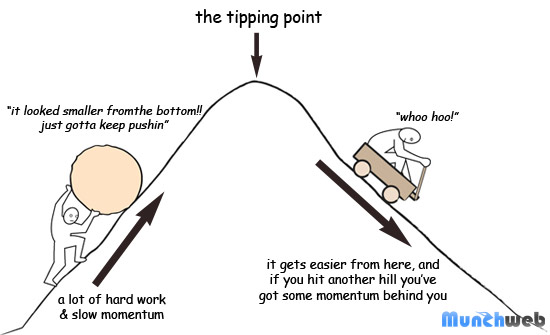
Two things predict arrival at the tipping point:
- Sufficient effort
- Sustained effort
You have to do the work and there is no shortcut. That means writing while implementing all the advice you’ve read, not just continuing to write the same way without implementing new techniques. That’s not real practice and doesn’t count toward the tipping point at all. Many writers don’t understand this. Act on advice so that you improve, and keep going.
If you stop before the tipping point, the rock rolls back down the hill. You’ll be crushed by the process and much less likely to try again. Go on without stopping until it starts to feel easier, and then keep going.
Only failures quit.
Stop Chasing Unicorns
Comparison is the thief of joy.
Theodore Roosevelt
Every industry and creative endeavour has its rock stars. They are the titans whose success dwarfs all others. Each has such a massive audience that acclaim is almost guaranteed, whatever they produce.
You might notice that their later output isn’t actually stellar quality. No matter. They’re at the far end of the curve, and now receive high rewards for less effort. Their situation is the reverse of yours.
None of that matters to you.
They struggled in the beginning and stayed the course to make it. And the environment in which they succeeded is not like yours, because time has passed and everything changes. Their past success has nothing to do with your future success and does not prevent you from seeking it.
Stop reading them and indulging in self-flagellation or angry rants about their content. This is the embodiment of drinking poison and expecting the other person to die. It hurts you and only you.
Compare yourself only to past you. Are you moving in the right direction? Don’t chase unicorns, chase your future.
Serve Your People Better
“I haven’t got an audience,” you say. But you’re here and I guess you have a few followers or readers. The number isn’t big enough for you yet, but it’s not zero.
So what are you doing for those people? Are you like those annoying corporations who woo new customers with all their best offers and leave their existing customers in the cold? You’re so focused on the people who don’t know you that you turned your back on those who do.
Some people are watching. Some people have shown interest and faith in your work. Think of them as individuals, which is what they are. What are their needs, fears, and dreams?
Then ask yourself how you can meet their needs, nurture their dreams, inform and support and entertain. You’re here to serve in some way, so dive deeper. Give your fans 100% of your effort and knowledge and insight.
Discover the problems your actual audience has right now, and offer solutions.
An Inconvenient Truth

When you’re used to putting in the work and seeing direct results, this is a particularly hard pill to swallow. The action ⇢ result switch appears to be broken because you acted but nothing happened.
This is true — but only in the short term. If you continue and keep faith in the process, you’ll find that what you’re seeing is not failure, but delayed success. Keep going.
Time For A Reality Check
I know you want to give up because I want to stop too. The things I want seem too far away, and my efforts are too small to make a difference. I’m tired.
At this point, you need to remind yourself of your effectiveness. When you feel useless, it bleeds out into a generalised despair. But you’re not a total failure. You’ve succeeded at many things already both large and small. You’ve survived life so far.
I had a professional mentor once who I found almost impossible to work with. I needed the six-month placement to complete my training. Most of my days were spent just surviving because you can tolerate any job for six months, right?
I barely made it.
Almost nothing of what he tried to teach me remains, except this. He advised me to keep a compliments file. Since it was inevitable that someone would complain about my work, and I would feel bad about myself, the compliments file provided a reality check.
You feel like you’re useless and everybody hates you. But other people enjoy and are grateful for your work. Print out those comments and emails. Keep them in an actual file that you can see and feel. Person A felt your words helped them. Person B found your advice useful. Person C loved your way with words.
Recall your life successes, whether it’s a diploma awarded or a joke well told. Balance your negative with all the positive you can muster. Go find your nice comment, print it out so it’s tangible, and look at it to remind yourself you’ve won before, and you can win again.
You Can Conquer The Swamp of Suck On Your Path To Greatness
You’ll always have good and bad days. Know yourself and your triggers to navigate your downswings more easily. When you feel better again, think about how you got there and what you need to avoid or mitigate the trigger.
Cherish positive comments and hoard them for encouragement in difficult times.
Every win is a treasure. Track them, acknowledge them, be grateful for them.
Celebrate when you reach a milestone. Don’t just shrug it off and look at the next goal. Attach a treat to each milestone because the top of the mountain is a long way off. Even those who conquer Everest make camp along the way.
List your goals and write a reward next to each one. The only rules are
- the reward must be within your power to give and
- the reward must make you smile.
Do it now.
Your Engine Is Inside The Car
We quickly adjust to new situations, whether it’s more money, a bigger car, or the next thousand followers. These things lose their ability to motivate us and we say familiarity breeds contempt.
Extrinsic motivators like metrics and fame work for a while to pull you along. But if you don’t have them yet — and even when you do — you need intrinsic motivation. This is your engine. The small voice that won’t be silenced, that says after all this struggle you are still gonna write anyway and be damned because not writing is even worse than writing without immediate reward.
It is the combination of reasonable talent and the ability to keep going in the face of defeat that leads to success.
Martin Seligman
So go forward, and write anyway. What else are you going to do? Take what you have, and keep going. I’ll see you there.
How A Small Win Paves The Way To Big Success

There comes a point in every long project where you’re too far from the beginning to stop and too far from the end to go on.
You have a plan. You work to execute your plan and somehow you’re still no closer to that distant goal you set. You’re tired and more than that, you’re discouraged. Is it all going to be worth it in the end? You’re not sure any more.
Finishing a novel, hitting a target weight, or remodelling a home are examples of long term endeavours that are definitely worthwhile. Yet many of us run out of steam, part-way to victory.
I found myself in this position with my writing goals. Ideas ran dry, motivation deserted me, and facing the blank page morphed from exciting possibility to anxious dread.
I needed something different.
Think Different
By knowing the large you know the small; and from the shallow you reach the deep.
Miyamoto Musashi, The Book of Five Rings
It might seem at first sight that the simplest tasks are very different from complex ones. But even making a sandwich involves weighing alternatives, assessing and acquiring materials, and execution of linked processes. The difference is that success is practically assured and most importantly, within easy reach.
Large and small share the same DNA.
So turn away from your big project and do something small, trivial even. It must be easy to complete and yield a tangible result. By completing a task with a finished product, you reinforce feelings of competence. A small win becomes the building block for a bigger effort and a bigger win.
This isn’t procrastination. Procrastination is unfocused avoidance. This is deliberate. This is trimming the rudder, a small action that points you more directly at the goal. The process of achieving a minor win makes the large win more likely by boosting your confidence.
The Future Looks Bright
How does this work in practice? Here are two examples from gardening and writing.
When we moved to our current home we acquired a large grassed space at the back. I wanted a garden. But even planning the garden, let alone executing all the changes needed, was overwhelming. And we had no money and limited time.
So instead I planted flower bulbs, five or ten at a time. This small job fitted between childcare and working and cost little. It was a microcosm of the larger space in planning, preparation, feeding, and planting.
Long form works often grind to a halt, perhaps more so if you’re a pantser like me. I’ve written about ways to get moving again if you’re truly exhausted, but sometimes you just need a little boost.
At this point with my novel, I’d write something else. Song lyrics and poetry, haiku if I wanted a really quick win. A short story for my writing group which ended up in our anthology. Some of these pieces have never been shared, but that isn’t the point. The point is to recalibrate, compress the task of writing into a smaller space and to reach the end.

So go and write your haiku. Plant some bulbs. Sweep the yard.
Find your win.
When you taste a drop of victory, you’ll believe the whole bottle is within your grasp.