blog, creativity, productivity, self improvement

How To Persevere When You Feel Like You’re Failing Creatively

Simple tips for maximising success as a creative

astronomy dark dawn dusk
Photo by Matheus Bertelli on Pexels.com

I want to be a cat in my next life. Cats are great role models. A well-loved pet would be ideal, but since I’m a cat that’s not essential.

I can rely on sharp claws and keen senses to feed and defend myself. I carry myself with supple grace, accept affection on my own terms, and find the warmest spot in the house to sleep. Sounds pretty good.

But in this life I set goals and strive to exceed them. Sometimes that works. Today I’m tired and a little disheartened, because the reward for my efforts is unpredictable and I can’t figure out what’s worth repeating.

You’ve probably had days like that too. Days when endless hustle and failing forward feel like hitting your head against a brick wall, over and over. Days when it’s hard to believe in yourself and stay motivated.

Can you rediscover your appetite for the hunt? Can you be more like a cat?

A Numbers Game

Not everything that counts can be counted. Not everything that can be counted counts. — William Bruce Cameron

Comparison might be the thief of joy, but we still have to track our stats. How else will we know where we stand?

Looking at numbers drives you to a kind of madness. Whether you count views, followers, pounds lost or lifted, or revenue, numbers draw you in. The world shrinks to a set of digits that you then equate to your own value.

If they’re going the wrong way, heaven help you and the people around you.

Peak madness is achieved by then comparing those numbers to other people’s numbers. You inevitably come up short because you only look at the most successful — those who you hope to emulate someday.

But you want someday to be today. You want the bragging rights, the book deal, and the interview on a popular TV show — now. Hasn’t it been long enough? Probably not. It takes much longer than you think or want to build success.

Remember when you longed for just one fan or even ten reads? Other writers are still there, hardly out of the starting gate. You’ve moved past that, and as long as you keep creating you’ll move past your next milestone too. Perhaps there are other measures of your impact.

Views and reads matter to writers, but they don’t map exactly to engagement. Look at comments, however brief. Out of your whole audience, those who comment are the most engaged fans. They take time to read, vote, and then reach out to you.

Treasure your commenters. Reply and thank them for their time and interest. Make a connection. I won’t pretend claps don’t matter, especially if money is involved. But when you’re still some way from your next milestone, the smallest dopamine hit of approval is welcome.

Like No-one Is Watching

A flower blossoms for its own joy. — Oscar Wilde

There’s deep satisfaction in doing something well. Craftsmen of old spent time making sure the back of an object, though not usually seen, was still beautiful. You can turn a finely tailored jacket inside out and find no loose stitches or raw seams. Every part of a created object reflects the skill and attention of its creator.

Writing can be art, but it must always be craft. Your writing should be the best you can produce. Live by the Beyoncé principle: over-promise, over-deliver, and keep on growing. Standards vary from day to day, but should never be less than good. Make it good, then make it better.

How do you know it’s better? On your down days, take your latest finished piece and compare it to your work of six or twelve months ago. Look at those older pieces and see how they could be tightened and polished further.

The same applies to losing weight, getting fitter, or learning a skill. Look back at where you started, review your SMART goals, and progress becomes clearer.

There’s a long way to go yet, but you’re on your way so give yourself credit for the journey so far. Take a reward for effort, and keep going.

You want to be known for consistent high quality. Henry Ford said quality means doing it right when no-one is watching. One day, those eyes will be turned on you. Be ready.

No Shortcut to Greatness

A few years ago I bought a car from a doctor at the start of his career. He was selling the car to help fund his planned attempt on Everest.

Wait a minute. Mount Everest? He wanted to be an Army surgeon. He also wanted to climb Everest before he was thirty. Both goals required a ton of hard work, so he made a plan that matched his impressive ambitions.

Now imagine someone builds an elevator that goes to Everest’s peak. Almost anyone can book a ride and stand at the top. How impressive is that? Not very.

The fact is, we value what we pay for. And the reverse is also true; we don’t value what we get for free.

How does that connect with writing or whatever business you’re in? It means the hard work you do is integral to the payoff you get. The harder you work, the sweeter the reward.

Now you can reframe the work as building a bigger payoff. Giving your work both intrinsic and future worth carries you through the inevitable gloomy days when the wind dies in your sails.

Don’t drift in the doldrums when that happens. What you do when you’re losing is the measure of your character. Get out the oars and start rowing.

Riding Out The Storm

But this time you can’t row. You’re caught in a perfect storm; work, health, relationship or financial issues make it impossible to do more. You’re barely surviving as it is. What to do now?

Maybe you can’t lean in, but you can limit backsliding. Three things will help you.

  1. Harness the power of a tiny goal. Write for five minutes, exercise for ten minutes, meditate for three minutes every day. Set the bar so low you’re bound to win. The little wins accumulate to stop your sense of mastery from fading completely. Choose your goal. Mark a cross on your calendar each day you achieve it. Winning streaks have power.
  2. Work on strategic aims. Get into the not urgent but important box of tasks you mean to do sometime but haven’t yet. Watch a tutorial on that software you bought but can’t use. Do some digital admin; clear out old files that clutter your desktop, file your receipts, check your antivirus is up to date. Use the Pomodoro technique and work in fifteen-minute bursts. Finish one job before starting another.
  3. Focus on the goal. Picture yourself at the finish line. What will you need to get there? Do you need extra training or equipment? A goal is a dream with a deadline, so don’t spend too much time thinking. Planning is a prelude to action and not a substitute for it.

Dreaming With Eyes Open

Sometimes you can fake it till you make it; other times you can’t. When the fears of not good enough and you’re going to fail take hold, you’ll struggle. Struggle is an inescapable part of life, of daring to hope for better. Hold fast to dreams, but know that they aren’t enough to get you where you want to be.

‘The principle of moving forward, as though you have the confidence to move forward, eventually gives you confidence when you look back and see what you’ve done.’ — Robert Downey Jr

A cat doesn’t make a jump by staring at its feet all day. It focuses on the landing. If it falls short, it digs in its claws and scrambles up. Then it sits and licks a paw as if it exerted no effort at all to reach the target.

Keep moving, whatever you have to do, however tiny the progress. Look back only to remind yourself how far you’ve come already, then turn your eyes forward to the peak. It’s always uphill to the top.


(first published 30.7.19 in Mind Café on Medium )

Have a comment? Drop it below.

← Back

Thank you for your response. ✨

blog, Pat Aitcheson writes, poetry, relationships

Retrograde

stars man torch_martin-sattler
Photo by Martin Sattler on Unsplash

listen to this poem here:

This place I’ve been before
almost home
a shoe that didn’t quite fit
I’m sliding in anyway

(close my eyes)

can almost see the way we were
hear your laughter unravelled in time
distance draws the bitter barbs
leaving only the ghost of sweetness

(let’s pretend)

feast on crumbs of forgotten memories
rake it over, find one last spark
call it enough
better than nothing at least

(a once-familiar kiss)

it only looks like backward motion
from where I’m standing
so stay with me awhile
and I promise not to cry

(we already know how this ends)

listen to this poem narrated in reverse here:


(with thanks to Wil Roach – first published in PS I love you on Medium 28 July 2019)

blog, Pat Aitcheson writes, productivity, writing, writing process

It’s Time To Call Yourself a Writer – And Mean It

Own your title and stand tall.

woman holding a pile of book in front of red letters spelling the word LOVE
Photo by Renee Fisher on Unsplash

In order to write the book you want to write, in the end you have to become the person you need to become to write that book.
Junot Diaz

I know your secret.

You want to share your secret — but also you’ll never tell, because then the truth would be known and you’re not ready for that.

It’s time to reveal yourself.

You’re a writer. There, I said it.

Are you already blushing and stuttering, denying what you know is true? Maybe feeling a bit angry at being exposed? Then read on, because you need to fix this immediately.

But Are You Though?

If you can’t stop thinking about it, don’t stop working for it.
Michael Jordan

Most writers realise their calling when still young, though some come to it later. Hobbies and interests come and go but those of childhood have a tendency to remain, even if they’re driven underground by adult responsibilities.

Some avid readers remain just that, while others start making up their own stories. You might not have written a word for years, yet the idea nags at you. You keep a journal or scribble bits of poetry when you feel sad. You read novels and think you could do as well — if not better.

These moments can be the beginning of a writing career if you go from thought to action. Dreaming gets you nowhere, you must act. Talking about it, thinking about it, or planning it isn’t enough.

To be a writer, you must write. And you must finish your stuff.

A chef doesn’t serve a raw pie. A surgeon doesn’t down tools halfway through closing a wound. And a writer finishes what she starts, no matter how hard it is.

Stephen King said that if you’ve paid a bill with money earned from writing, then you can call yourself a writer. That’s true for a professional, but we all have different goals and money is only one.

A writer has an itch, a compulsion, a need to express themselves in words.That’s you, and you want to know how to own it.

Not In Public

Writing is not necessarily something to be ashamed of, but do it in private and wash your hands afterwards.
Robert Heinlein

So you want to call yourself a writer, but something is holding you back. Perhaps you remember being dismissed or ridiculed by someone whose opinion mattered — a parent, teacher or friend. They told you writing poetry was banal and writing romance was pathetic wish-fulfilment.

They told you your words were no good, and by extension, you were no good.The resulting shame caused you to bury writing where nobody could find it and use it against you.

Things are different now. You’re grown, and nobody can tell you what to do. These wounds run deep but you can heal them without therapy.

  1. Recall what was said and who said it
  2. Write it down
  3. Write a letter to that person telling them they were wrong
  4. Burn or tear up the letter

Anyone can write, just as anyone can cook. But not everyone can do it well. Maybe you think you’re not good enough because you’re not Neil Gaiman or Stephen Covey yet.

You must practise. Write a thousand words, then ten thousand more. Make writing a central part of your life so that it becomes familiar. Lose your fear of the thing you love and get good.

No Words To Say

Put one word after another. Find the right word, put it down.
Neil Gaiman

Imagine this scene. You’re at a social gathering and someone you know asks, “So I hear that you write, what are you working on?” They smile encouragingly. What do you do?

  • Flight — you get away as soon as possible without answering
  • Fight — you deny it or make some self-deprecating remark
  • Freeze — you’re terrified and unable to speak

You’re a writer and words are your tools. It’s time to use them.

You need two stories; one for you and one for your work.

a woman wearing face paint in the shape of an eye mask
Photo by Patrick Fore on Unsplash

What Would Super Me Do?

Beginning. Middle. End. Facts. Details. Condense. Plot. Tell it.
Transformers: Revenge of the Fallen

Picture yourself as a confident writer. If that’s too difficult, create an alter ego (why do you think authors use pen names? Just for anonymity?) A superhero writer who looks like you but acts like she was born to do this.

Now ask yourself WWSMD? What would Super Me do?

She’d face her questioner and smile. Then she’d say something like, “That’s so kind of you to ask. I’m working on some short stories/ editing my novel/ posting on my blog.”

When the follow-up questions come, she’s ready with the address of her blog and an elevator pitch for her book. She isn’t ashamed of who she is. But she isn’t her work either; it’s part of her life, not her whole being.

So use your skills and write those stories. Write the description of you as you are now, making the best of your position. A single sentence should do. Make it active and avoid using the word ‘try’.
“I’m writing a YA novel in my spare time.”
“I’m blogging about gardening.”

Then write the next part, where you anticipate the follow-up questions. Be vague; say it’s at an early stage, or in editing, or that you plan to find an agent in the future.

If someone is asking personal questions like how much money you’ve made, don’t get angry or embarrassed. Find words that you can say with a smile, then change the subject.

“When I make my first million, I’ll let you know!”

Writing an elevator pitch is a great exercise for any novelist and forces you to condense your story into its essentials. Try it, and you’ll find it easier to write queries, blurbs, and synopses.

Do not put yourself down by saying that your writing isn’t serious, or that you’re no good. Nobody wants to hear that. Don’t apologise. Avoid any opinion, just stick to the objective facts.

No Fear

I have learned over the years that when one’s mind is made up, this diminishes fear; knowing what must be done does away with fear.
Rosa Parks

Fear is at the heart of our troubles.

We don’t tell the truth about our work and ourselves because we fear an imaginary outcome. As writers, we’re blessed and cursed with well-developed imaginations, full of monsters and disaster.

It’s never as bad as you think it will be.

Practise in low-risk settings first. Try out your routine on a trusted friend, in the same way Chris Rock tests his routine in small clubs before going on tour. Tweak and adjust until you feel happy with it.

As you get more confident, expand your arena. Last year my online writing group produced an anthology of short stories. Each writer was tasked with getting people to be part of the street team who would be early reviewers. Did I want to approach people and ask for something? Hell no.

After I calmed down, I wrote a short Facebook post that started with, “As some of you may know, I am a writer.” Writing it down was less scary than speaking it out loud. Two surprising things happened.

First, lots of people agreed to be part of the launch — not always the ones I expected.

And second, I introduced myself to my social network as a writer, and the sky did not fall. In fact, it became much easier to say it in person.

Claim Your Title

Claiming your title as a writer is simple.

  1. Write stuff — and finish it.
  2. Release old programming that doesn’t work for you anymore.
  3. Write your story of the new you.
  4. Practice makes perfect.

Soon you won’t need an alter ego because you will become Super Me, proud writer and not afraid to say it.

Go on, you can do it. Start today.


(first published in The Writing Cooperative on Medium 21 July 2019)

have a comment? drop it below

← Back

Thank you for your response. ✨

blog, creativity, productivity

6 Signs Your Creative Project Is On Track – Even Though You Doubt Yourself

You’re doing better than you think

Graffiti of "trust your struggle" in green paint on grey brick
Photo by DJ Johnson on Unsplash

Without ambition one starts nothing. Without work one finishes nothing. The prize will not be sent to you. You have to win it.
Ralph Waldo Emerson

How are your creative projects going right now?

When you start your book or your business, it’s both scary and exciting. Your motivation is high and you can see your progress.

Then you hit a wall, where you discover how hard it’s really going to be. But you pushed on, and now you’re in the middle somewhere. Maybe you’re questioning yourself, or maybe other people are feeding your uncertainty by pointing out problems or deficiencies – or by getting much better results than yours.

Whether it’s a day job or your side hustle, you’re working and planning and getting stuff done. But are you doing enough, are you seeing results, are you getting there – in short, are you winning? 

More to the point, do you feel like you’re winning?

It can be difficult to know where you are when there are no maps and few signposts along the way. Some behaviours are markers of future success, as long as you keep going. You can use them to gauge your progress.

You look forward to doing your work

Pleasure in the job puts perfection in the work.
Aristotle

As a newly qualified doctor, I regularly worked 70-100 hours a week, with very little sleep when on-call. The long hours were difficult at times, but I loved my work. Learning new skills and doing something I believed in outweighed the fatigue – at least in the early years.

When you love what you do and can’t imagine not doing it, you know you’re on the right track. Stress and resentment come from slogging away at something you hate. 

When the game’s worth it, you’ll put in whatever it takes.

You do the grunt work without complaint

Perhaps this is how you know you’re doing the thing you’re intended to: No matter how slow or how slight your progress, you never feel that it’s a waste of time.
Curtis Sittenfeld, The Man of My Dreams

Every job and activity has boring grunt work. Singers practise scales, gardeners pull weeds, artists clean brushes, and everyone does paperwork. Grunt work is repetitive and unglamorous. It also makes better skills and tools so that you can get on with the beautiful act of creation.

When you perform the menial tasks of your work mindfully, you elevate them. You see that there is really no difference between pouring concrete in a foundation that’s never visible, and carving a fine oak fireplace that will be admired. Both are integral to the finished house. Both deserve your care and attention.

How you do the small things is how you do the big things.

You’re focused on process rather than results

If you trust in yourself. . .and believe in your dreams. . .and follow your star. . . you’ll still get beaten by people who spent their time working hard and learning things and weren’t so lazy.
Terry Pratchett, The Wee Free Men

Making stuff happen is hard work. You’re on the right track when you focus on what is within your control. You can produce, but you can’t directly influence how your product is received or how well it performs. 

Steve Jobs said that real artists ship; and he implied that they make another and continue to ship. Nobody remembers Apple’s Newton PDA now. It failed, but looking back we see it clearly as the ancestor of tablets, touch screens, and more. Jobs stayed focused on realising ideas that were ahead of their time; eventually, the world caught up.

You have one job – execute your ideas using functional processes. Pay attention to your results and use them to guide the next iteration, but don’t get hung up on apparent failure. You might simply need to refine, repackage, and repeat – until you create an iPad.

Your win is out there.

person holding red strawberry
Photo by Aphiwat chuangchoem on Pexels.com

You grow your skills

Anything is better than stagnation.
Arthur Conan Doyle

You know that experience isn’t measured in years but in growth. It’s not enough to write a thousand words every day. Those words must be better and more effective over time. To do that, you seek out feedback and opportunities to learn. 

Successful people are not threatened by the skill of others, they’re inspired by it. You’re humble enough to realise that mastery is always out of reach, but striving for it gives your creative life meaning. And since teaching something is the proof of learning, you’re comfortable sharing your knowledge with others. 

You are only in competition with yourself.

You reach flow states often

To pay attention, this is our endless and proper work.
Mary Oliver

Remember the last time you got so caught up in your stuff that suddenly it was dark outside, you’d missed dinner and three hours had vanished? That magical state of flow happens when you’re fully absorbed in something that is challenging and enjoyable.

While it can be hard to summon a flow state at will, take notice of how you get there. Then aim to replicate it as often as you can because 

Flow proves you’re definitely doing the thing you were made for.

You own your identity

Your art is what you do when no one can tell you exactly how to do it. Your art is the act of taking personal responsibility, challenging the status quo, and changing people.
Seth Godin

Yes, impostor syndrome is real and you’re as prone to it as anyone. But at some point on your journey, you’ve become comfortable with your title and status.  

You stop qualifying it or hiding behind your day job, and one day you describe yourself as a writer, or entrepreneur, or artist first and wage slave second. Or if your paid job is your passion, you express that without shame.

Feeling secure in your own skin is a sure sign that you’re further on in your growth than you think. Don’t allow others to project their own fear of failure onto you. 

It’s not arrogant or boastful to own and celebrate your successes, large or small. 

On Your Way

Make your work to be in keeping with your purpose.
Leonardo da Vinci

Six behaviours show that you’re doing the right thing in the right way.

  • You look forward to your work
  • You do the grunt work without complaint
  • You focus on process, not results
  • You grow your skills
  • You reach flow state often
  • You own your identity

Success is never guaranteed; all you can do is shift the odds in your favour. Fortunately, that is within your power.

When you find the right path, keep going.

blog, creativity, Pat Aitcheson writes, productivity

The World’s On Fire And The Sky Is Falling – Create Anyway

colourful photo of graffiti artist by Maxime Bhm via Unsplash
graffiti artist using spray paints by Maxime Bhm via Unsplash

In a time of destruction, create something.
Maxine Hong Kingston

The world is on f*cking fire — Bill Nye said it so it must be true.

When your house is on fire you grab your prized possessions and run. But when the world is on fire, there’s nowhere to run. Faced with the constant stream of bad news, you could be forgiven for simply giving up.

What’s the point of your life’s mission when everything’s going to hell? Your tiny contribution can’t hold back an endless ocean of misery.

It’s so hard to keep going when you’re not succeeding like you hoped, so you might as well binge on ice cream or gin or Netflix.

What’s the point of creating?

A Day In A Life

We’re given only a limited time to make a life. Life has the meaning you give it, no more or less. Meaning comes from finding and using them to do your thing despite all the negativity.

There’s someone out there who needs your thing, right now. That could be entertainment, the tools to do a job, or a map to navigate heartbreak. They see themselves in your thing and it gives them hope.

I once wrote a scene in which two gay men argued about being their authentic selves. A woman sent me a long comment saying she wept, thinking back to the compromises she made in earlier life. She felt it was her story, and for a moment she was less alone.

Emotional connection transcends time, gender, or place. Without connection and authentic feeling we wither and die. That might sound a bit dramatic when you look at a blog post or poem you just wrote, but you can’t know the state of the person who receives your message.

Who knows what your creation could achieve?

The Small Stuff Is The Big Stuff

Think back to a time when you read something that spoke to you. There was probably nothing Pulitzer-worthy about the content in itself. Yet on that day and for you particularly, those words sparked a feeling or a memory. You felt as though someone reached into your chest and peeled away the layers protecting a soft spot.

You felt seen and heard.

Those words were written for you, even though the writer didn’t know that. Like a singer who shatters a glass with a high note, words resonate with a frequency that the heart answers.

Now consider all the myriad ways we struggle each day. We carry our pain and that of others. We try to live a good life. We try to be happy. But often we fail. That’s when we need help.

Create something that can help, even if you don’t see how. Offer perspective, advice, or encouragement. Share your tools, your story and your gifts.

Remind people that there’s always beauty and hope to be found, even if you have to dig through dirt to find it. Remind people that the sun is hidden behind dark clouds, not gone completely.

Once you put your creation out there it no longer belongs to you. It’s a child of your imagination, and it will make its own way in the world. Your job is to make it strong, and let it go.

Lives can be saved and hearts repaired by the smallest of acts. You might never know who you reach, but they’re waiting right now. Defy the darkness.

Go create.

(first published 26 June 2019 by Publishous on Medium)


I’d love to hear your thoughts. Leave them below.

← Back

Thank you for your response. ✨

blog, creativity, productivity

Why You Shouldn’t Show Your Work – Yet

red flower
Photo by Pixabay on Pexels.com

The caterpillar does all the work, but the butterfly gets all the publicity.
George Carlin

Art is ugly.

Recently I watched the TV series Sky Arts Portrait Artist of the Year. Each week, artists are challenged to make a portrait of a live sitter, in public, in four hours.

The most surprising lesson is how often the interim stage looks like a failure. There’s nowhere to hide for the artists, who are interviewed as they work. Not infrequently they despair of pulling it together in time.

Viewers see the awkward proportions and clashing colours, and agree. It doesn’t look good.

And yet, in the end, beauty emerges. Sometimes it seems that the painting only comes to life with the final few brush strokes.

You might be agonising over the scattered, ragged appearance of your current project. You study the polished, glossy work of those you look up to, and despair.

But you’re missing a vital truth.

Not Great Yet

There is nothing in a caterpillar that tells you it’s going to be a butterfly.
R Buckminster Fuller

A few years ago I took up watercolour painting as a complete novice. I love watercolour, but I had a lot to learn about the process of producing something pleasing to the eye.

The interim stages of a watercolour are often confusing and unattractive. The colours are wrong, things are missing, it looks flat. For a long time, it seems to be all wrong.

But as long as the drawing is right and you keep going, it will turn out okay. If you work on it more, it might even turn out great. The essence of watercolour is layers. You have to be patient, letting each one dry before adding the next.

Each layer reveals a little more of the picture you’re aiming for. Each stage hints at the finished article, but is only a step in the right direction.

To make a finished article you need two things: a map and a defined endpoint.

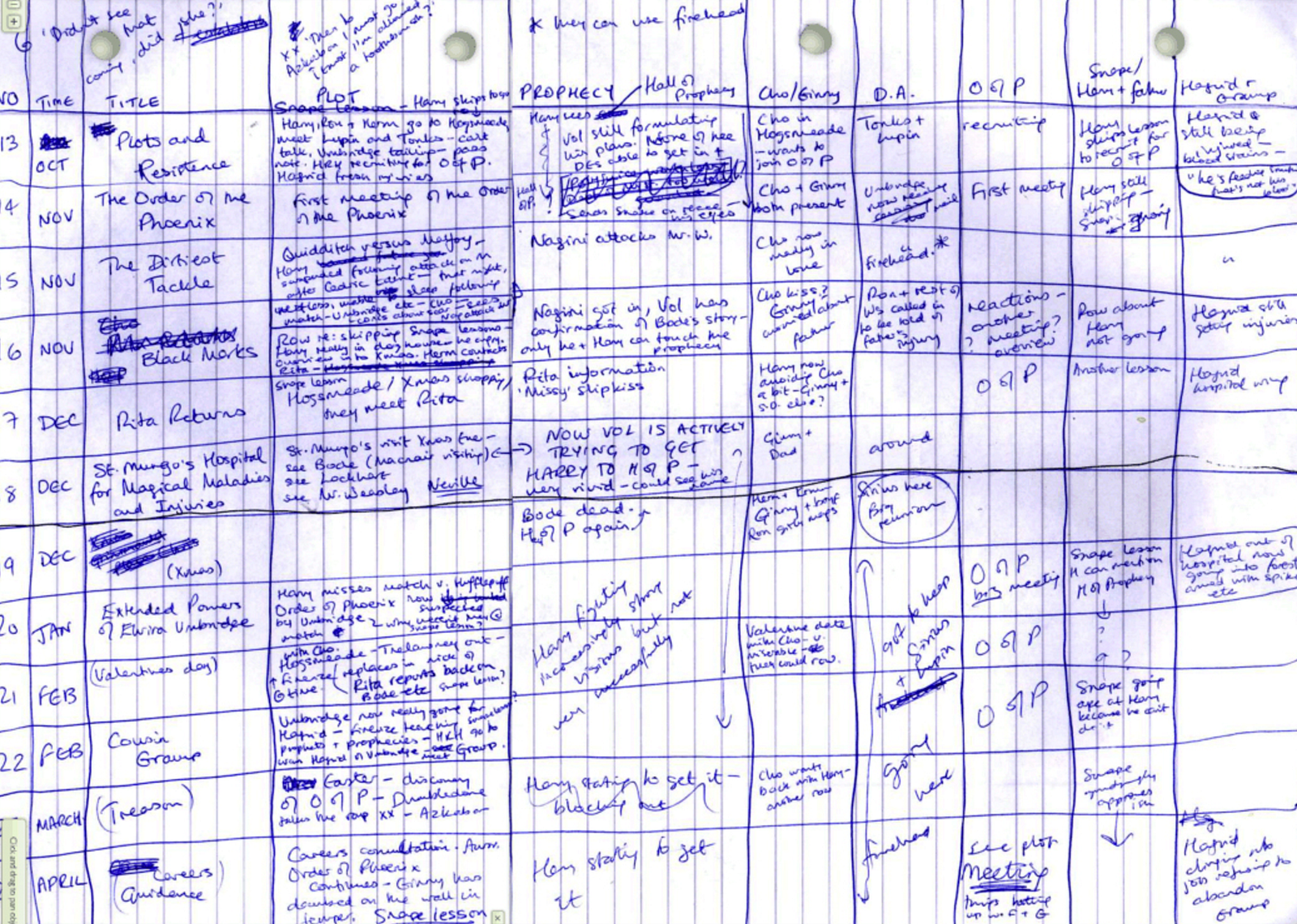
Look at this example.

image from Huffington Post

JK Rowling plotted one of the longest books in her Harry Potter series by hand, on paper torn from a notepad. No Scrivener, no Evernote, nothing fancy. She saved fancy for the ideas that powered her words.

Rowling had the end in mind, so she was able to endure the development phase where things didn’t look so pretty. Don’t be seduced and discouraged by picture-perfect workspaces and elegant bullet journals. Real work often involves getting messy.

A story, a painting, a child, or a life all have their ugly duckling stage. Have the end in mind. You need to keep faith with your project and keep moving forward.

Above all, do the work — but don’t show it until you’re ready.

It will be beautiful, but you’ll only see it when you get to the end.

(first published by Publishous on 12 June 2019)


Comment or suggestion? Drop it below.

← Back

Thank you for your response. ✨

blog, Pat Aitcheson writes, self improvement

How To Talk To People -10 Tips For Better Conversations

How to make small talk less of a big deal

happy people talking daytime
Photo by Helena Lopes on Unsplash

The trouble with her is that she lacks the power of conversation but not the power of speech.
George Bernard Shaw

Imagine you’re going to a party. You know the host and a couple of other guests. There will be drinks. There will be small talk.

Are you excited to meet all those new people? Or are you shrinking away in horror and already thinking about faking peritonitis to get out of it?

You’re not alone.

There are two kinds of people in this world. The first go by the Irish principle of strangers being friends they haven’t met yet. And the second live by Sartre’s principle that hell is other people. Unfortunately for the latter, they also have to socialise at least occasionally.

Good conversation is like a well-paced game of tennis, neither too fast to return serve, nor failing to return and letting the ball drop. Here are ten tips to help you raise your game, whichever camp you’re in.

1. Assume rapport

Wisdom is the reward you get for a lifetime of listening when you’d have preferred to talk.
Doug Larson

If you struggle with talking to strangers, approach them as though they’re someone you know. Assume you already have a friendly connection. Drop your shoulders, breathe out, offer a smile or a brief but firm handshake as appropriate. Odds are they feel the same about you, and you’re not intimidating, are you?

2. Listen more

We have two ears and one tongue that we might listen more and talk less.
Diogenes

Most people wait until the other stops speaking and then weigh in with their own observations. Active listening is a technique that aims to ensure the speaker feels heard. And since most people want to talk about themselves, they will think you’re great if you let them. Listen, acknowledge by gestures such as nodding, and then summarise what they said before responding. Try, “So what you’re saying is…”

3. Avoid interrogation

The primary use of conversation is to satisfy the impulse to talk.
George Santayana

A rapid-fire series of questions isn’t just hard to respond to, but can come across as aggressive. Relax and let them answer one question at a time. Remember you’re meant to be listening, and if your questions come in a constant stream you aren’t really listening or responding.

4. Don’t choke

That’s all small talk is – a quick way to connect on a human level – which is why it is by no means as irrelevant as the people who are bad at it insist. In short, it’s worth making the effort.
Lynn Coady

It’s easy to mock small talk about the weather, the game, or property prices, but they’re safe and universal subjects to get things started. You might fear you have nothing to say, but there’s always something. Look at the local newspaper or trade magazine before you arrive to see what the hot topics are. If you don’t watch the current big thing on TV, have something else to talk about in books or movies.

5. There’s an art to delivery

It’s the way I tell ’em.
Frank Carson

We draw a great deal of meaning from the way speech is delivered. Practice a stance you’re comfortable with and avoid closed body language. The words are often less important than tone, speed, and clarity of speech.

Breathe evenly. Adjust your volume to match the room. Speaking too fast will lose your listener, and too slow will bore them. Keep your point in mind so that you don’t meander and lose the thread of your statement.

Some people are effortlessly funny, some are unintentionally funny, and then there’s the rest of us. Comedians are masters of timing, but even they practise their material in low stakes situations  before headlining their national tour. Avoid telling jokes unless you’re confident, but laugh at them whenever possible.

6. No monologues

A conversation is a dialogue, not a monologue. That’s why there are so few good conversations: due to scarcity, two intelligent talkers seldom meet.
Truman Capote

Even if you’re the most knowledgeable person on the topic being discussed, avoid monopolising the conversation. You don’t know what other people know and you risk coming over as arrogant. Remember that conversation is a game in which both parties speak and listen. If you hold forth, you’re lecturing and people’s eyes will glaze over. We’ve all been trapped by the single subject bore. Don’t be that person.

7. No open combat

Conversation isn’t about proving a point; true conversation is about going on a journey with the people you are speaking with.
Ricky Maye

Conversation is not a full-contact sport. Rein in the need to be right all the time and keep away from arguments. If someone tries to pick a fight with you, decline. Move away, feign ignorance, or change the subject. Social gatherings are rarely a good setting in which to confront people. If you think you’re superior to other people, keep it to yourself and consider you’re probably wrong.

8. Steer away from controversy

The real art of conversation is not only to say the right thing at the right place but to leave unsaid the wrong thing at the tempting moment.
Dorothy Nevill

In a mixed gathering, there will be a range of opinions on any subject. Deeply held convictions are not going to change over the canapes, and that includes yours. One of the great joys of life is discussing deeper issues, but reserve that for the right audience. Avoid politics, religion, and any charged subject from the news.

If you’re faced with someone espousing views you’re absolutely opposed to, you have the right to move on. Don’t put up with unnecessary discomfort. Socialising is hard enough.

9. Practise emotional intelligence

Silence is one of the great arts of conversation.
Cicero

Be aware of the person you’re talking with. Do they show signs of interest with open body language? Are they oriented towards you, the exit, or someone else? One of the worst sins is constantly scanning the room for the next mark. This makes the other person feel ignored and insignificant. If you see someone else you want to speak with, finish your conversation and excuse yourself politely.

Know when a conversation has ended and try to move on with grace. Pay attention to cues.

On the other hand, if you do connect with someone, ask open questions and listen. If you want them to say a bit more, try waiting combined with encouraging actions such as smiling or nodding. Often people will respond again to fill the silence. If not, offer something of your own. The best conversations happen when both people are relaxed and willing to reveal something true about themselves.

10. Know your limits

Introverts, in contrast, may have strong social skills and enjoy parties and business meetings, but after a while wish they were home in their pajamas…many have a horror of small talk but enjoy deep discussions.
Susan Cain

Extroverts are energised by social contact, whereas introverts are drained by it. Both need other people to varying extents. If you’re introverted, plan accordingly. Watch your energy levels and leave before you’re exhausted. Accept that you’ll need a period of withdrawal to recharge and work it into your schedule as a priority.

Don’t Sweat The Small Talk

Brave the introductions and small talk, and introverts have a chance to find a kindred spirit who’s happy to chat in a quiet corner while the extroverts work the room. If you’re lucky enough to go with a more outgoing partner or friend, that might offer the perfect cover. You’ll still have to drag them away at the end though.

Treat small talk as a starter for ten rather than a trial. Life is all about making connections and that means being comfortable with social situations, whether you prefer talking or listening.

You can’t get to the deep without first going through the shallows.

(first published by Publishous on Medium 8 June 2019)


Have a comment? Drop it below and start a conversation.

← Back

Thank you for your response. ✨

blog, productivity, writing, writing process

5 Things Fiction Writers Can Learn From Non-Fiction Writing

write well in any genre

two smiling women in red sitting in snow with books
Photo by Ben White on Unsplash

Writing is writing, and stories are stories. Perhaps the only true genres are fiction and non-fiction. And even there, who can be sure?
Tanith Lee

There are two kinds of people in the world; those who like fiction, and those who have no time for anything but facts. Although creative non-fiction has blurred the boundaries between the two types of narrative, classic non-fiction is rooted in verifiable truth as seen by the writer.

Even if you write fiction exclusively, good non-fiction has much to teach you whether it is memoir or exposé. Every writer wants their message to be heard in the way that they intended, so let’s see what non-fiction has to offer.

Just The Facts

When you write non-fiction, you sit down at your desk with a pile of notebooks, newspaper clippings, and books and you research and put a book together the way you would a jigsaw puzzle.
Janine di Giovanni

Research underpins non-fiction, providing both material and evidence for that material. When you write highly imaginative fiction you might feel you can skimp on research, but this is a mistake. The action might take place in a distant galaxy or your home town, but get the details right and convince your reader that the events you describe could really have happened.

Andy Weir’s book The Martian took an improbable situation – astronaut stranded alone on Mars – and resolved it using actual science. That solid grounding in truth ignited its early popularity with readers who preferred authenticity rather than hand-waving the explanations.

Historical fiction such as Anthony Doerr’s All The Light We Cannot See clearly requires in depth knowledge of the period setting. However, only the salient facts need appear on the page. Like an iceberg the majority remains hidden, but familiarity with all your source material will allow you to write your characters and settings with conviction. 

Avoid dumping facts on the reader unless they serve the story. Nothing halts narrative flow as much as indigestible lumps of information. Find a way to feed it into dialogue or action instead.

The Shape of Things

One of the underestimated tasks in nonfiction writing is to impose narrative shape on an unwieldy mass of material.
William Zinsser

Any piece of non-fiction sets out to tell a story or make a case for something. Achieving that aim depends on a solid structure that takes the reader through the facts and arguments in a logical way. A traditionally published non-fiction book starts life as a proposal in which the author sets out chapter headings and content before it’s even written.

Sometimes it’s difficult to get started on a piece because the main theme or endpoint is not clear in the writer’s head. If you can’t define your own ideas it will be impossible to take others with you.

You need a plan that you can work with before starting to write. If like me you’re a pantser who writes to discover what happens, you’ll find this more difficult to accept. But it will save you wasted hours and unfinished pieces if you have some concept of the ending and a few of the high points along the way. 

Study story structure using the hero’s journey or screenwriting beats or whatever you prefer. Then apply what you’ve learned. Be open-minded enough to try a different way of doing things. Having a defined structure is not death to creativity. In fact you’ll find your creativity can truly blossom inside constraints.

If your stories tend to fizzle out, go back to basics. Are you telling a story with a beginning, middle, and end, or is it an anecdote? Knowing where the story ends and what changes the characters undergo on the way is vital to crafting a satisfying tale.

Nothing But The Truth

Creative nonfiction writers do not make things up; they make ideas and information that already exist more interesting and often more accessible.
Lee Gutkind

 We consume much of our reading online, and time is of the essence. Since your reader is subjected to a fire-hose of content every day, your duty is to make time spent with your words worthwhile. 

The best non-fiction is written with clarity and economy of expression. Fiction also benefits from both. Perhaps the tone of Strunk and White doesn’t suit your historical family saga, but consider the time you’re asking your reader to invest in it. Edit and edit again to remove padding and tighten your prose. Run your work through the Hemingway app to make sure it’s easily understood by your target audience.

Most first drafts can be cut by at least 10% without losing meaning or voice. Write freely, let it rest for a while, then edit with a ruthless hand. 

A Clear Focus

I don’t read for amusement, I read for enlightenment.
Joyce Carol Oates

The non-fiction author follows an outline which focuses on the central argument of their book. Their book must inform and might also entertain, but it has to be relevant to be successful. Some readers believe that fact is more exciting than fiction, so they expect a factual read without flights of fancy. Non-fiction writing styles and subjects reflect that preference.

Fiction readers vary in how they want their entertainment served up. Some want real facts woven into their historical fiction, some want real science woven into their science fiction, and some want entire flights of fancy that never were. 

Know who your reader is and what they want. Make sure you supply a happy ending for romance, a solution for the mystery, or whatever your genre requires.

If you’re not clear on genre conventions, read more books until you’re sure. Study blurbs and reviews until you have a good grasp of the current landscape. Always keep your reader in mind and leave them better off, whether cheering for your characters or more informed about a current issue.

A Certain Freedom

In fiction, when you paint yourself into a corner, you can write a pair of suction cups onto the bottoms of your shoes and walk up the wall and out the skylight and see the sun breaking through the clouds. In nonfiction, you don’t have that luxury.
Tom Robbins

The image above might be fanciful, but the basic idea is true. Even creative non-fiction doesn’t normally include making things up. The writer must stick by their research. That being said, some writers argue that since memory is reconstructed there can be no absolute truth and the lines are blurred. 

Although there’s no one way to approach non-fiction, it always starts with facts.

But as a fiction writer you are free. Free to reimagine, embroider, and invent what you need as long as it’s consistent with the world you write in. You can populate your real world with imaginary characters, or your imaginary world with real characters. As long as your story has something true to say about being human, you can start and finish where you like. 

That freedom is both exciting and scary. Use it to elevate your fiction. Use all the tools at your disposal, wherever they come from, and show us what you can do.

If the memoirist is borrowing narrative techniques from fiction, shouldn’t the novelist borrow a few tricks from successful non-fiction?
Darin Strauss