Writing about the creative life and the stories all around us
Author: pataitcheson22
When not working, I'm probably writing, gardening, travelling, taking photos, reading, or going to concerts. I write poetry and fiction. I write about the world. And I leave some of my words here.
You tell yourself that you’ll get back to it later. When the kids are grown, when you retire, when you have more money…then you’ll learn the guitar, get back to painting, write your novel.
Or you tell yourself it’s too late. Too much time has gone by and you can’t change your body, your relationship, your job. So you settle for the inevitability of further decline.
There’s no escaping the march of time. But it holds opportunity too.
An Acorn Is Not A Tree — Yet
Somebody is sitting in the shade today because somebody planted a tree a long time ago. Warren Buffett
The idea that we overestimate what can be achieved in the short term and underestimate what can be achieved in the long term has been attributed to Bill Gates, among others.
It’s like failing to harvest mature wood from an oak sapling, then abandoning it because you think it will never grow big enough to be worthwhile.
Often we start something in a flush of enthusiasm. But when it doesn’t yield significant results immediately, we get discouraged and give up. The gym routine, language class, or novel is dropped because you thought for sure that a month or two of effort would be enough to make progress.
But take a different view. How would future you feel if you persevered with small efforts now? In five years, what can you achieve by daily practice?
Graphic designer Ethan Tennier-Stuart showed stunning improvement over five years. Every skill responds to deliberate practice. Talent has to be matched with effort to achieve its potential.
All difficult things have their origin in that which is easy, and great things in that which is small. Lao Tzu
Everything starts off small — a word, a note, a brick — but put enough of them together and you can build something astonishing.
Write two hundred words daily and you’ll have enough material for four novels. Writing over a third of a million words is guaranteed to hone your skills.
Years ago I wanted to write seriously. But I was juggling home and work and exhaustion, and couldn’t see how to find time or energy for it.
So I committed to one hundred and fifty words daily after dinner, whatever happened, even if I just typed I’m so tired over and over. Sometimes it was gibberish but eventually those words turned into short stories, then a novella.
If I’d waited for the ideal conditions I might never have started. My daily goal was tiny, but that’s exactly what made it achievable. Persistence pays off in the end.
When it comes to ageing, we can’t turn the clock back. But we can slow some processes down. Future you will thank present you for wearing sunscreen daily, cutting out that dessert or bread roll, and getting enough sleep.
Walk thirty minutes daily and you’ll see your health improve. Make time to connect with a child daily, and reap the benefits. You’ll build better connection in fifteen intentional minutes daily than in the most amazing annual vacation.
It’s all about building big improvements in small increments.
One step after another in the right direction will take you as far as you need to go. Don’t discount any small amount of progress — success is built of innumerable tiny actions.
The man who moves a mountain begins by carrying away small stones.
Confucius
Make time work with you, instead of feeling helpless.
Time will pass anyway, so use it to build something you’ll be proud of. Pick up your first pebble right now and start to move your personal mountain.
Perhaps you’re like Bruce Banner, hiding behind a mild mannered facade that conceals constant rage. You live in fear of what anger might do, fear of unleashing it, and fear of the consequences.
In real life, expressing anger leads to loss. You can lose relationships, health, possessions and in some cases your liberty by getting angry with the wrong person at the wrong time.
So that makes anger a bad thing, right?
More Than A Feeling
Feelings are something you have; not something you are. Shannon L. Alder
We can’t escape anger. But maybe you’re shaking your head now because I’m wrong about you. You don’t get angry because it’s unproductive, destructive and just not nice.
Do you get irritated? Are the people around you consistently disappointing? Irritation and frustration are anger with the volume turned down.
Do particular situations that don’t directly involve you trigger a desire to call out injustice and unacceptable behaviour in others? Moral outrage can be a proxy for real anger with its roots elsewhere.
Are you a perfectionist, hypercritical of yourself, and need to control even small aspects of your environment? This combination of internally directed anger and fear hides under a veneer of achievement and desire for approval.
Last of all, are you always nice to everyone, in any situation? Do you apologise when someone wrongs you? People who bury their feelings under niceness and socially sanctioned compliance are often angriest of all.
Everybody’s angry at least some of the time. Why is this a useful response?
Anger helps you survive because it motivates you to approach a threat and overcome it.
When some guy cuts you off in traffic, you feel a threat to your territory — your vehicle and its surrounding space. You’re enraged and you’re ready to get out and fight.
By contrast, fear motivates you to avoid a threat to survival. If that same guy is driving an eighteen-wheeler, survival instinct tells you that fighting him for the same road space is unwise. But unexpressed anger doesn’t necessarily go away. You hold it in your body and mind.
When your child spills his drink later, you shout because your head hurts and you have heartburn and is it so hard to just use a cup? Now you’re both angry with yourself and guilty, and you reach for your numbing agent of choice.
Emotions are not of themselves good or bad. You have emotions, and your choices in dealing with them have more or less value. There are ways to make anger work for you.
Count To Ten?
When angry, count four. When very angry, swear. Mark Twain
Anger is processed very fast in the amygdala, part of the brain that deals with identifying and responding to threats. The cortex, seat of rational thinking, takes longer to catch up. This is the reason behind the advice to count to five or ten, giving yourself time to think of an acceptable response.
Anger triggers an alert state, with stress hormones flooding the system. Heart rate and breathing increase, muscles tense, and the body gets ready to fight. You can learn to tune in to these reactions before your anger escalates too far. Long, slow exhales help to limit the effects of adrenaline. This is essential; otherwise you’ll be at the mercy of emotions and unable to make a considered move.
If you live or work in an environment where anger is often expressed, you know that getting angry doesn’t help the situation. But sometimes anger escapes before you can direct it.
I once had a patient whose spouse had left him and their young children. He worked hard to care for them but had to sacrifice much of his previous lifestyle to do so. We spent time unpicking his many symptoms, which required various referrals and treatments so that he could keep going.
One day he came to discuss his progress. He said nobody was listening and he felt uncared for. This wasn’t so uncommon. Normally I’d listen, give him space to vent, and then formulate a plan.
That didn’t happen.
It was like a switch was flipped. Instead of empathising, I challenged him directly. We remained civil — we’re British after all — but ended without resolving either position. He never returned to see me.
I was already tired and running on empty for a variety of reasons, but I thought my emotions were under control in a professional setting. Turns out that if someone hits where it hurts by implying you don’t care so you’re not doing a good job so you’re not a good person then knee-jerk responses can outrun the best training.
When you’re already carrying a stress load, your trigger point is much lower. You might need to walk away from or avoid situations that you know will be difficult to manage. If that’s not possible, at least you can recognise your shorter fuse and be ready to count to twenty if needed.
Take a time-out if needed. Defer the conversation to a later time. Be self -aware and respectful of the other person, so that you can broker an acceptable resolution.
Afterwards find a trusted person to debrief with, or write a journal entry. Go over the events, be honest about what happened and own your choices. Treat it as a learning opportunity and plan a better course of action next time.
Most of all, resist the impulse to turn the anger on yourself without resolving it. That will eat you from the inside.
Anger motivates action, so choose your action. And if your previous actions hurt someone, apologise sincerely, forgive yourself, and move on.
Don’t let anger rule your life; there is a better way forward.
Anybody can become angry — that is easy, but to be angry with the right person and to the right degree and at the right time and for the right purpose, and in the right way — that is not within everybody’s power and is not easy. Aristotle
So you recognised your anger for what it is and learned to control your first impulse to attack. What comes next?
Think of it as an energy source; a laser that can be focused with great effect. Hold that energy and take aim.
Start with the physical. Your body has been wound up to deal with a threat. Work through the adrenaline flooding your system by running, lifting weights, or digging the garden. Exercise is a healthy response and the answers to fix the original problem may well come to you on that fast walk around the block.
I use my angry energy to do domestic chores that I hate. Afterwards I have a clean house and my muscles can relax. The negative encounter and all the thoughts following are converted into tangible benefits, which is a win-win situation.
If your anger is prompted by injustice for others do something to help, however small. Give time or money, or speak out. Take your anger and turn it into something real and useful.
If it’s a person or a situation in your life, talk it over with a third party to see what your options are. Trying to organise change in the white heat of anger will lead to questionable decisions. The other person can also dismiss your reasonable grievances as mere emotion — which will enrage you even more. Figure out what exactly makes you angry and only then seek the solutions.
Some people will goad you to snap so that they remain in control. Family members especially can be adept at button-pushing. Do not give them that advantage. Know your trigger points and plan how you will respond in advance. Instead of having the same argument over and over, change the script. Remember that the only actions you can control are your own.
If you’re angered by being put down or treated as insignificant, redirect the energy. Use it to work on your weaknesses and enhance your strengths. Spite and the desire to prove someone wrong has propelled many success stories.
If your anger is internal, driven by poor self-esteem, shame, or lack of belonging, these need careful handling. Facing the truth about your feelings can be the hardest of all. Think back to your last bout of anger. Dissect your feelings using the 5 Whys technique and a journal. Name the pain before you can cure it, with or without external help.
If you’re too nice with undefended boundaries, learn how to say no. The energy you save by not feeling resentful can be used for something better — like your own ambitions.
If you’re angry all the time, for trivial reasons, understand this is a symptom of something deeper. Strain in your relationships is a warning that change is urgently needed. Take responsibility both for your chosen actions and the results. Nobody makes you react in a particular way. It is always your choice to give in to your initial impulse.
Seek ways to manage your anger and work on your stresses. As Marcus Aurelius said, the consequences of anger are much worse than their causes. The ability to keep your cool is an advantage in many situations.
Win Your Cool
Holding on to anger is like grasping a hot coal with the intent of throwing it at someone else; you are the one who gets burned.
Buddha
Anger carries the energy of a coiled spring. Holding it in requires more energy than letting go, but you need to handle its release with intention so it doesn’t blow up in your face. This is neither simple nor easy, but learning self-control has a tremendous pay-off in mastering your emotions.
Hardwired into every one of us, anger is neither hero nor villain. It’s a call to action which, when properly managed, can be turned from indiscriminate bomb into a targeted weapon for change. Temper your anger with clear thinking so you can focus it with precision.
Know your anger, embrace it — but not too tightly — and use its power for good.
Dark stories are told, but time passes so fast you’ll find that precautions are not built to last.
Watch out little children, you better take care
when those who know better tell you to beware,
when those with long memories shudder and sigh
be sure something fearsome will come by and by.
You might love your fairy tales, sugar and spice
without realising such tales are made twice.
The first is to make trembling humans afraid
of glowering monsters that creep in the shade.
The second, to gloss over, sweeten and soothe
for those without courage, the unvarnished truth.
Just call me Cassandra, who did try to tell
there are many roads to the portals of hell.
Through study and practice I long ago learned
to master the hunger that endlessly burned
in flesh bone and marrow, secreted within
my heart and my essence, the voice of my kin.
Dark, difficult magic. This had to be done
to shackle the devil. There was only one
small gap in my armour, for try as I might
no lore can delay the day’s turn into night,
or heavenly bodies that spin on their track
and one day align. Then the beast will attack.
I swear that I told them they must stay inside.
I hopelessly begged all the children to hide.
No prayer, incantation or druid’s wise rune
will silence the call of a super blood moon.
My wolf broke its bonds, howling vengeance. And here
came answering cries of my clan far and near,
my brothers and sisters all hungry to feast
on flesh of the great, and the bones of the least.
Unfettered by reason and drunk on our might
the slaughter proceeded beneath the red light.
I woke to regret, utter carnage around.
We cannot leave anything here to be found.
There is no escape, chained to life by this curse.
But I would exchange all the gold in my purse
to be once again a mere mortal — to die
and pay for my sins as blood drips from my eye in sad imitation of genuine tears.
I mourn for my victims across countless years.
We buried the last of the bodies this morning.
The foolish and brave, who did not heed my warning.
Tell them to write a story about anything. No guidelines, no limits!
There’s only one thing more scary than a blank page – a blank page and a totally free hand.
That’s because we are easily overwhelmed by too many choices. But isn’t more choice a good thing?
The Tyranny of Choice
The more constraints one imposes, the more one frees one’s self. And the arbitrariness of the constraint serves only to obtain precision of execution. Igor Stravinsky
Suppose you want to buy a jar of honey. On your way home from work you stop to fill your car. The filling station has just two kinds of honey so you pick one, job done.
But if you go to a major grocery store like Tesco they carry thirty-seven kinds of honey. Now you have to weigh many more options. Do you prefer clear or organic or lavender honey? It’s all too much so you end up grabbing the closest jar – or nothing at all.
Researcher Barry Schwartz calls this choice overload. Choice overload leads to picking the default rather than consider options, decision fatigue, and choice avoidance.
Making a choice requires energy, and if you’re already tired or depleted from too many prior choices you’ll either avoid the choice or go for the easiest option. This is death to creativity.
Creativity is about connecting things, but it’s also about solving problems in novel ways.
Constraints help you innovate without having to consider every option.
My writing group has an exercise called Hot Pen. One person opens a novel to a random page, another chooses a random number, and the nearest noun or verb on that page becomes the one word prompt. We then have ten minutes to write a story based on that word.
Scary, yes, but the variety of stories is always amazing. It’s surprising how each writer finds a different angle within a very small space. How can you limit your options to release more creativity?
No Problem
Problems are hidden opportunities, and constraints can actually boost creativity. Martin Villeneuve
Constraints are good for creativity and can be set up in different ways.
Time – a deadline to force completion or a target to hit
Subject matter – writing to a set theme or prompt
Resource – limited budget, materials, or word count
Try these practical ways to get started.
Setting time limits – the Pomodoro technique is essentially a rolling set of mini-deadlines.
Work with limited forms like one hundred word drabbles or sonnets.
Once you’ve made a choice, stick with it. There will always be other options out there. Your job is to get started and then go on until the end, because only completed work can be edited, and only edited work can be perfected.
These techniques are useful to overcome inertia at the start of a writing session. Once you begin, you’ll find it easier to jump into your main project.
Sometimes, too many choices make us anxious. Then, we need a box as a starting point. It needs to be small enough that it doesn’t paralyse with too much possibility – yet big enough that imagination can stretch its wings and fly.
Once we accept our limits, we go beyond them. Albert Einstein
(first published by Publishous on Medium 5 June 2019)
Every year it comes again, this subtle sense of loss — a missing piano note. I’ve erased and rewritten our story so many times over that the memory now is ragged and blurred. Too much clings to the fabric. There’s no space to start afresh.
Sharp edged criticism and disappointments have mellowed, tumbled over and over in an ocean of days and tears and never minds. What was once harsh and bitter turns soft and hazy. Perhaps one day even these will disappear, all the corners worn away until nothing remains.
I wonder if she ever heard me cry, holding jagged shards to my heart instead of comfort.
I cannot bear to wait for an echo that remains silent, so I do not sing the missing note. It sits inside my chest, bound and shackled.
Each early summer season it tries to escape. My throat is barricaded and I will not.
The past is veiled for my protection, bubble-wrapped in half-truths and semi-plausible explanations. We do our best and it is not enough. One always wants more than the other can give.
A never ending game played out across generations. Rules are unclear and the dice are loaded.
One day, my daughter too will cast the wishes I unknowingly broke into her private sea, hoping fragments will wash ashore smooth enough to hold.
Filled with too much or too little
(a little too much pain, I thought then.)
I thought I knew how life worked.
You were sunlight, floating carelessly
bright summer without end.
I thought I knew how seasons turned.
A flock of black umbrellas for a good man
steady drizzling grey, a leaden weight
that stops my breath, crushes my throat.
Earth rains from cold fingers
pattering on the lid
a fleeting thought of following it down.
I thought I knew how hearts worked
but there’s no fixing this
(too short, too little)
you couldn’t teach me how to smile today.
So I turn my face heavenward, swallow the sky
let its tears drown my despair.
I thought I knew –
Kindness and a generous spirit go a long way. And a sense of humor. It’s like medicine — very healing. Max Irons
What does it take to make your day?
It might seem that only the biggest things can turn a rotten day into a better one. You long for a scratchcard win, a £50 note discovered on the ground, a declaration of undying love, or a letter of acceptance for that thing you’ve been hoping for and dreaming about. Those things would certainly make you feel better.
They’re also almost guaranteed not to happen.
What are the odds, right?
But something changed my mind.
Work had been difficult, and then I caught a horrible cold. Think congested, feverish, head stuffed, can’t breathe, can’t sleep misery. Well, still gotta work, so I slogged on. After surviving one long morning in which all I wanted to do was run away home and hide under my blanket, there was a knock at my door. I expected another claim on my time and fading energy, and my heart sank.
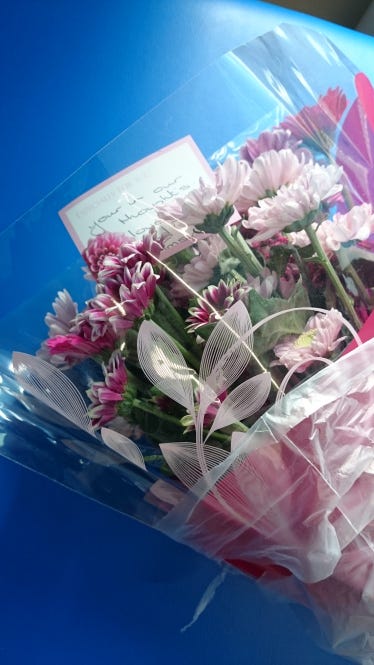
Instead, the receptionist brought in flowers. A pink bouquet with a card that read ‘your (sic) in our thoughts’. It had been left by someone I had seen earlier. I was so moved by this, I could have wept.
I work in a so-called caring profession. I have colleagues, family, and friends, some of whom knew how ill I felt. Yet this came from a near-stranger, who went to some trouble to help me feel better.
Even a humble daisy would have shown me she cared. And I let her know I appreciated her gesture, more than she knew. It made me smile on a tough day, and that can be the greatest gift of all.
The excellence of a gift lies in its appropriateness rather than in its value. Charles Dudley Warner
It takes so little to shine a light, and you never know who needs it most.
It need not be flowers; it can be any small, authentic kindness. Eye contact and a smile, a sincere inquiry followed by active listening are often missing in daily life. If we supply them and are genuine then we connect on a basic human level, and that’s what we all crave.
Make that tea or coffee without being asked. Drop change in the cup. Buy their favourite pastry, just because.
When backed by action, the thought really does count.
How could you brighten someone’s day? Look for ways to pay it forward. Go on — I dare you.
(first published 16 May 19 by Publishous on Medium)
Have you ever loved someone and it didn’t work out?
You tried, they tried, but ultimately you parted company. Then you were left to either heal a broken heart, or hide your relief at escaping something that had lost its shine.
When that happens a few times, you start to wonder whether love is all it’s cracked up to be.
Love is supposed to be our ultimate goal.
Most of us chase it all our lives, and sometimes even find it. But in the nature of these things, finding and keeping is not the same thing. There are different kinds of love of course, but our culture puts romantic love top of the list.
We act as though love is forever and yet we know it is not. We enter into contracts and exchange rings that symbolise an unending circle. And we quietly build exits and escape clauses in the form of prenuptial agreements, running away money, and the number of a good lawyer, just in case.
The Matrix Revolutions argued everything that has a beginning has an end. Why should love be the exception? Maybe as you lick your wounds from your last battle with forever, you ask yourself, “Is love ever a mistake?”
A few people get lucky, but most of us contend with detours and blind alleys before we find The One — if we ever do. That holds true whether we seek love or a life purpose or something else of value. Winning the ultimate prize is like running a maze with no idea if a solution exists, or if a lifetime is long enough to find it.
Why keep running when success seems more elusive than a lottery win?
Cross My Heart And Hope
Life can only be understood backwards, but it must be lived forwards. Søren Kierkegaard
You can’t know how your life will work out down the road when you can’t see the whole map. Perhaps there are no mistakes, only progress you can’t yet recognise.
When things seem to be going wrong, think of it as taking an unexpected turn on the road of life — a plot twist, if you like. Once made, your footprints can’t be erased anyway. We can’t change our past; we can only make peace with it.
With this in mind, look back at past experiences and take what can be learned from them. Some loves are like flowers; beautiful and doomed, and all the more precious because they are ephemeral.
But even more precious than love itself is the capacity to feel love not once, but many times. To have that opportunity, you need to draw on hope.
Hope encourages you to try again and trust that you’re making progress. Hope might lack the certainty of faith, but it persists even in the face of disappointment. Hope keeps you going.
Pandora found that when all is lost, hope is the tiny flame that lights up the darkness. And the deeper the darkness, the brighter it shines.
Hope can be a powerful force. Maybe there’s no actual magic in it, but when you know what you hope for most and hold it like a light within you, you can make things happen, almost like magic. Laini Taylor
From the moment of birth, you’re taught how to behave and be accepted in the world.
Adulthood means submitting when life knocks off the corners and edges that don’t fit in your assigned box.
Adulthood means growing up, and growing up means forgetting all those ridiculous daydreams.
Your parents and teachers told you not to waste your time dreaming, because it doesn’t lead anywhere. They taught you that success comes from hard work here in the real world, doing serious jobs. You took that lesson to heart, put your head down and became realistic about what you could achieve.
You forgot to look up at stars and sky, and wonder.
You were caught in a trap and told it was the right place to be. Society rewards conformity with peer and elder approval and punishes the maverick with exclusion and ridicule. Who wants to be that guy?
But your dreams didn’t go away completely. Occasionally you glimpse them out of the corner of your eye, when your brain drifts during a boring meeting or long commute. Sometimes the sight of someone else living your dream makes you envious or sad, and you can’t fully explain why.
Deep down, you know something’s missing from your life.
No Dreams, No Wings
If I’d asked my customers what they wanted, they would have asked for faster horses. Henry Ford
None of the technological and artistic advances we now enjoy were created by realists. Sure, when it comes to implementation, refinement, and exploitation, a concrete approach is essential. But concrete builds solid foundations. It does not let us fly.
Everything that exists in the world begins as an idea. An idea has no mass. It can be as expansive as your imagination. Ideas are limitless. Work must be done to manifest ideas in the real world, but dreaming is free.
Realism doesn’t produce innovation, it produces incremental improvement.To produce something new, you must first dream a new dream. That’s how the world got cars, airplanes, telephones, and computers.
That’s how you’ll get to where you want to be.
Voices In Your Head
You can’t believe everything people tell you — not even if those people are your own brain. Jefferson Smith
When you decide how to behave in a given situation, the voices of caregivers and authority figures loop endlessly, and often unrecognised, in your inner conversation.
Your father no longer scares you so much that you never look him in the eye, but when faced by an aggressive manager that’s exactly what you do without thinking. And you wonder why you can’t assert yourself.
When you find yourself browsing painting sets online, an old art teacher whispers that you don’t have an artist’s eye. And you click away because that’s not for you.
Here’s the thing. You’re an adult — no-one is the boss of you. You get to decide how you act at all times, and you take responsibility for your actions.
At some point you need to stop blaming parents, caregivers, teachers or others in your past for how you respond to life now.
The past experiences and attached emotions that make up much of your inner self-talk are no more than an outdated script. Once you realise that your reaction today is based on the memory of a conversation that’s decades old, you free yourself from it. That was then and this is now.
You can choose to respond differently and write a new script.
That’s when you truly grow up.
A Lost Child
The creative adult is the child who survived after the world tried killing them, making them grown up. The creative adult is the child who survived the blandness of schooling, the unhelpful words of bad teachers, and the nay-saying ways of the world. The creative adult is in essence simply that, a child. Julian Fleron
Everyone has their share of bad experiences. You’ve been shaped by them to some extent. Now it’s time to turn the page and write a new chapter with new rules. Acknowledge what feels bad and let it show you where you need to find something better.
This means rediscovering your inner child. Try books such as these to guide your journey. Or you might need to let go of your old programming and try new ways, like Julia Cameron’s artist dates in The Artist’s Way.
We are all innately creative. It is possible to be a functional adult and still retain childlike wonder and creative flow. Both are essential to a sense of wholeness.
From Reality To Fantasy
Without this playing with fantasy no creative work has ever yet come to birth. The debt we owe to the play of the imagination is incalculable.
Carl Jung
Now you know that cultivating dreams is not only good but essential and nobody can tell you otherwise, it’s time to examine what that means for you.
Although dreams look very different on the outside, they can be stripped down to a small number of basic desires.
Security: safety, stability
Love: belonging, bonding, intimacy
Esteem: respect, confidence, achievement
Self-actualisation: spontaneity, knowledge, purpose, and meaning
Understanding your underlying drives will help you see whether different approaches to similar goals are right for you.
One person might value respect, another stability. The first is happier writing well-reviewed literary fiction, the other writes copy that sells. Their dreams might look like ‘my novel is featured in The Times Literary Supplement’ versus ‘I support myself by writing for others.’
Both are writers but their dreams lie on different paths. Our desires form a hierarchy of needs and we are happiest when the earlier needs are met before seeking out the higher ones. That might mean your dream is on hold while you work on strengthening the foundations of life.
Look Inside
This visualisation exercise is designed to bring your dream into focus so that you can use it in the real world. I’m going to talk about writing, but it can be applied to anything you want to create.
Get comfortable and close your eyes. Breathe slowly. In the future, you’ve achieved your dream. What does it look like?
You’re typing on a new laptop in a cosy study, and your days as a wage slave are behind you. You’re holding a copy of your book in Barnes and Noble. A bus drives past advertising the film of your book. At a party, you say confidently, “This is my latest project.”
Now zoom in on specifics. What are you wearing? Is the bubbly in your glass Prosecco or beer or mineral water? Use all your senses. Turn up the brightness and create a vivid picture.
There Are No Limits
If you want to be a number one bestselling author, touch the cover of your book. If you want to finish first in a triathlon, hear the spectators’ cheers. It can only come true if you first create it mentally.
When you have the picture and the feeling that comes with it, fix it in your mind with an anchor. The anchor is a physical sensation. Linking the sensation with the vision makes it easier to recall. Pinch your thumb and middle finger together firmly while picturing your dream in all its multicoloured glory.
Practice frequently until you can recall the dream with ease, simply by pressing your thumb and middle finger together.
Great athletes use visualisation to increase their chance of winning. They have a clearly defined image of success, and that allows them to work towards it knowing that they are heading in the right direction. And the image can be a comfort when things are not going so well. The prize is still out there, waiting for you to reach it.
Where Are You Going?
It doesn’t matter where you’re going, as long as the destination matters to you.
Once you have a dream fixed in your mind, you can check activity against whether it moves you closer to your goal or away from it. That might mean giving up chocolate because you’re training hard, or putting your great novel aside to make enough money to live on by writing copy.
Either way, you’re in charge. You own your decisions and their consequences. You stop making excuses. Your destiny is in your hands.